
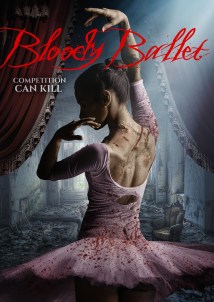
 Bloody Ballet (aka Fantasma) certainly starts off promisingly enough. Snow falls heavily in the night sky as approaching police cars begin to illuminate the solitary figure of a young girl standing still, unmoved by the cold and completely unresponsive. The haunting score swells as the slow motion scene unfolds to reveal the bodies of her brutally murdered parents and I am officially hooked. Of course, it’s one thing to get the audience’s attention and quite another to actually hold it.
After the opening scene the movie flashes forward to follow a professional ballerina named Adriana (Kendra Carelli) who we soon learn is the girl from the beginning. Adriana’s initial excitement at being cast as the lead in the Nutcracker is quickly tempered by the fact that her fellow ballerinas startgetting murdered all around her and worst of all, the killer has the same eye-gouging m.o as whoever killed her parents.
Bloody Ballet was initially released in 2017 under the title Fantasma and the cynical part of me can’t help but notice that the new VOD re-release (under a more audience-friendly title) happens to coincide pretty closely with the theatrical release of the Suspiria remake. Of course, if there was ever a film to try and ride the coattails of into the spotlight that would be it because Bloody Ballet is more than just a little Giallo inspired.
As the masked, black-gloved killer slashes his way through synth-scored scenes drenched in red and blue light it’s clear that this film is wearing its Argento influence firmly on its sleeve. That’s actually not a bad thing in this case though because while it’s clearly not a high budget film, the production design (particularly in the more stylized scenes) is a highlight of the movie. The real star of the show however are the kills which are stylish, surprisingly brutal, and feature a significant amount of ocular trauma.
It’s always nice to see solid kills in a horror movie but in this case they are interspersed between a series of scenes featuring unconvincing acting and a plot that starts out wobbly and nose-dives into terrible toward the end of the film. The general concept is good but it doesn’t help that the character of the journalist feels completely superfluous and the supernatural elements of the story are awkwardly and clumsily shoehorned in. I’d be more willing to forgive these issues were they not coupled with the most egregious of filmmaking sins, the blatant and utterly gratuitous use of voice-over exposition.
Having the characters waste dialogue on multiple occasions explaining motivation and plot points that are already glaringly obvious is bad enough, but when the V.O kicks on at the end just to make sure it’s really, really clear I felt an overwhelming urge to throw my remote at the TV. Apparently, writer/director Brett Mullen hasn’t had the concept of “show, don’t tell” explained to him and I was somewhat surprised that he didn’t simply cut to a scene of himself reading the script out loud to the audience before climbing out of the TV to literally beat us over the head with it.
It’s really a shame that the quality visuals of this film have to be tainted by these ill-conceived and avoidable missteps, but this is definitely a case where an aggressive re-cut could greatly improve the end result. If Mullen simply removed all traces of V.O and trimmed off the scenes that didn’t move the central plot forwarded there would be a very decent film here, assuming there was enough footage left to still qualify as a feature.

 The demonic possession sub-genre of horror is one that ebbs and flows in popular consciousness but never truly disappears. Perhaps this is because the idea of losing control to a powerful unseen force is something that can have the ability to instill a profound sense of dread within us, at least when it’s executed properly. Whether or not it factors in a heavy dose of religious anxiety, as they usually do, the general concept of demonic possession is a well that’s been dipped into many times and with the success of recent films like Hereditary, you can expect that trend to be on an upward swing. This means that for films on this topic to stand out, there needs to be more to their plot than a by-the-numbers rehashing of The Exorcist and today we’ll see if Luciferina has what it takes to stand out from the crowd.
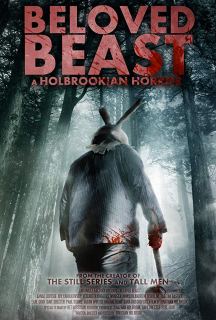 Writer/director Jonathan Holbrook’s new film Beloved Beast is his latest example of what has come to be known as ‘Holbrookian Horror’ following his excellent 2016 feature Tall Men. The term is apt because much like that film, Beloved Beast is imbued with the director’s signature style, one that successfully channels the surreal Americana of David Lynch, while maintaining it’s own unique flavor. In both cases, the viewer gets the feeling of slipping into a cozy nightmare, one that you want to envelop you as you willingly slide into the depths of its subtly surreal world.
 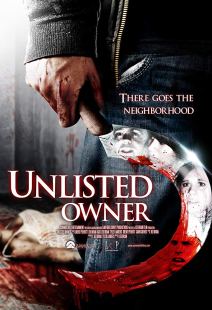 Ahhh, the found footage sub-genre, staple of the independent filmmaker. Some entries are notable and utilize that technique for innovative storytelling, but many others are simply trying to cover up low production values and a lack of budget. Ever since The Blair Witch Project exploded onto the horror scene in 1999, and raked in a quarter of a billion dollars on a $60,000 budget, filmmakers have been trying to capture a piece of that low-cost, high-profit magic.
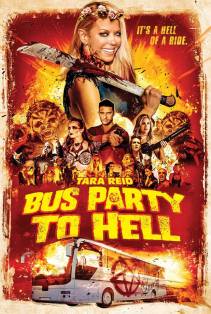 When a movie is titled Bus Party to Hell and features a masterclass thespian such as Sharknado alum Tara Reid, you have a pretty good idea what you’re in for. Of course, there’s nothing wrong with an over-the-top film that doesn’t take itself too seriously, provided it’s actually enjoyable to watch. There’s a surprisingly thin line between outrageously fun and irritatingly stupid and today we’ll see if BPtH falls more along the lines of the campy, gory fun of Father’s Day or the interminable slog that is Kudzu Zombie.
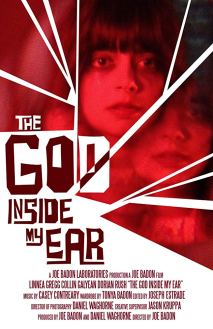 Creating a surreal film that really works is an incredibly difficult feat. In the hands of masters like Lynch and Jodorowsky the final product can be a multilayered work of art with symbolism and subtext that will have people in spirited debate for decades. On the other end of the spectrum are the myriad of films that bombard the viewer with “weird for the sake of weird” imagery, with no inherent meaning or intent, and no subtle clues to decipher what’s going on until we are simply told. Any surreal film is bound to fall somewhere along this line and today we’re going to see how close to the top (or bottom) The God Inside My Ear ends up.
 The incredible advances in digital technology over the last few decades have made it more possible than ever for aspiring and indie filmmakers to make their vision a reality, or at least attempt to. Freed from the burdens and excessive cost that goes along with shooting on film stock, many indie directors will attempt to replicate the lavish production values of multi-million dollar films with elaborate DIY sets and numerous on-screen characters. This almost always results in a disastrous final product but is still a far more common practice than the more sensible approach of using a small cast and a primary central location.
 The idea that alternate realities could simultaneously exist in the universe is certainly an interesting one and a concept that has become ever more pervasive in the popular consciousness of late.
 It wasn’t that long ago that horror anthology films were far less common than they are today. They never went away entirely of course but once the 90s rolled around they were pretty much relegated to cheap, straight-to-video cash grabs, most of which have been deservedly forgotten. That all changed with the success of modern anthology horror like Trick ‘r Treat and The ABCs of Death which revitalized a subsection of films that seemed destined for irrelevancy. As someone who is a big fan of anthology films, I couldn’t be happier with the unprecedented quality and abundance of these films today. Of course not all films are created equal and today we’ll see if The Forces of Horror Anthology feels more like a product of the modern anthology renaissance or a throwback to the dark days of the ’90s.
 It takes an unbelievable amount of work to make a feature length film and of course the longer your film, the more work it requires. This is why it’s unusual to see films venture past the standard ninety to a hundred five minute window, and downright rare for scrappy indie productions to attempt it. But this is exactly what writer/director (Jakob Bilinski) did with his ambitious and, uh, interestingly titled Three Tears on Bloodstained Flesh. Now, ambition is good, but it’s only half the battle so the real question here is, “how well does he pull it off?”

