
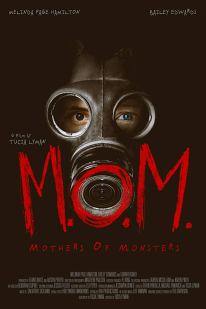
 Ever since The Blair Witch Project exploded onto the horror scene in 1999 and crushed the box office to the tune of a quarter billion dollars, countless filmmakers have tried their hand at tapping into that low cost Cinéma vérité style magic. Now that it’s 21 years later any filmmaker looking to utilize that format needs to bring something more to the table than abandoned footage found in the woods. Fortunately, M.O.M (Mother of Monsters) does bring an innovative twist to the standard formula as all the footage comes directly from cameras that characters use within the world of the film.
This approach alone isn’t unique but the justification and execution make it work better than most. Old home movie footage is spliced with straight to camera testimonials and consumer grade home surveillance as Abbey (Melinda Page Hamilton) obsessively documents the actions of her teenage son Jacob (Bailey Edwards). The more we see, the more it seems that this strung out single mother has good cause to worry as Jacob kills animals, has violent outbursts, and makes troubling maps of his school. Is Abbey uncovering the genesis of a dangerous criminal in the making…or is something else entirely going on?
Since the film devotes so much run-time to trying to make the viewer wonder about Jacob’s true motivations, it’s unfortunate that an early scene on an overpass heavily tips the scales, clearly showing which character is capable of committing unrepentant acts of violence. While the scene itself is well done, the film would be far stronger without it and would allow for some actual ambiguity throughout the story. It’s a shame too since the novel approach actually does effectively make use of the found footage conceit in a way that is modern, innovative and justified (mostly) within the world of the film. It also maintains a storyline that does drag a bit in places but overall manages to be engaging and at times all too real.
M.O.M’s true strength however is with its actors, which is fortunate as this is pretty much a two-hander between mother and son. The acting (and I cannot overstate this) is fucking incredible! Hamilton and Edwards truly live inside their characters and their pitch-perfect depiction is what makes the film work. The nuance and subtlety that they bring to their roles make this prescient story about a young man potentially going down a violent path feel even more dangerous and real. In a world where senseless acts of violence are commonplace, a film that reflects the anxiety that the true monsters can be found within the people we are closest to is a very scary concept indeed.

 As anyone who follows me on Twitter knows, it’s my mission to track down and review the most fucked up films ever made. Because of this, my idea of what truly constitutes Extreme Cinema may be a bit …..different than many people’s so I’m always at least a little skeptical when filmmakers contact me out of the blue and claim that their film is shocking and edgy. Still, I went into 29 Needles deliberately knowing nothing about it and keeping an open mind. Within the first few minutes one thing became perfectly clear, this is one film that DEFINITELY belongs in the Extreme Cinema category!
 offended in the process. Rape, mutilation, watersports and bloodplay are all on full display here as well as fetishistic acts that even I had never seen before (I have two words for you, eyeball tube). Writer/director Scott Philip Goergens clearly has a vision and takes a punk rock, no holds barred approach to executing it.
 Clocking in at under ten minutes total (only about seven of which is the actual film) Duérmete Niño (Rock-a-bye Baby) is an interesting little slice of horror. Inspired by a real, sleep deprived nightmare that director Freddy Chávez experienced after the birth of his daughter, this short captures the horror and anxiety of being a new parent in a very creative and unusual way.
 If you like your torture porn with a hefty helping of pseudo-philosophy, then Madness of Many might just be the film for you. At least, that’s what Danish filmmaker Kasper Juhl is hoping you’re into because his 2013 feature packs a surprising amount of both into its scant 73 minute run-time. Is this an effective combination? Should voice over be used in more than 90% of a film? Who the fuck are all these people being tortured and what exactly is going on here? Read on, for the answers to some of these questions in the review below!

 Ahhh corpse fucking, a taboo subject that even the most hardcore of Extreme Cinema films rarely delve into. Sure, directors are willing to mutilate teenagers with chainsaws and machetes all day but once you add in a touch of deviant sexuality it goes to a whole different level for most people. Obviously you’ve got your underground classics like the Nekromantik films or even a bizarre romantic drama like Kissed, but all in all it’s a pretty short list of films that make necrophilia the central focus. Of course, an essential entry to that list is Nacho Cerd
 Every detail inside the surgeon’s lab is so meticulously created that it gives an incredible level of authenticity to the overall film. This is helped greatly by the fact that it was filmed within a real forensic institute in Barcelona and that Cerd
 Cannibalism in film is generally depicted in one of two ways; either it’s being perpetrated by savage maniacs who messily devour human flesh or savored by members of high society as an indulgent and sophisticated ritual. As is immediately evident by the cover art, The Cannibal Club clearly falls into the latter category. These sorts of depictions tend to have an undercurrent of social commentary, as the rich literally devour the lower classes for their own pleasure and this film is no different in that regard. However, that is far from all that TCC has to offer as this delectable treat gives viewers a lot more to chew on.
 Fear not though gore hounds because there is still plenty of violence on display, especially as the film works up to its climactic ending. I also want to give credit to the fact that the social commentary is woven subtly and expertly into the story which gives the message a lot more resonance, especially in this day and age. So, if you are looking for an exotic and satisfying treat to satiate your darker appetites, you’ll definitely want to put this one on the menu.
 When working within the medium of short film it’s essential to communicate a lot of information in a small amount of time. Making the audience feel for the characters and telling a worthwhile story from beginning to end in just a few minutes is a very challenging task but Davide Melini’s Lion does all that and more within its concise runtime. Located entirely within the confines of an isolated family home somewhere in the snowy wilderness, Lion tells the story of an abused little boy who wishes his favorite animal could come and protect him from his own family.
 that makes an effort to establish the characters as real people and not just derivative stereotypes, thereby elevating the story above its basic setting. The feminist theme and social commentary also helps to set it apart and factors heavily into some major plot points (which I won’t spoil here) as well as dialogue that feels especially prescient today. It’s also nice that the characters (mostly) make logical decisions in service of their own survival although it does make it more noticeable the few times that they don’t. The twist nicely ties into the story thematically but it does make some of the earlier scenes feel like a bit of a reach as a result.
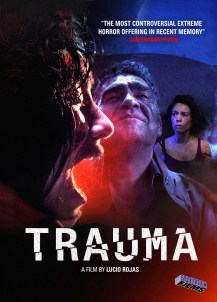 Incest! Necrophilia! Rape! Graphic murder! Have I got your attention yet? Because as a fan of Extreme Cinema the Chilean film Trauma certainly got mine. Some movies barely cross the line into Extreme Cinema territory, then there are others that grab the line by the fucking throat as they run past it. Trauma is certainly the latter, with certain scenes even echoing some of the most disturbing content from the legendary shocker A Serbian Film. Yet, at least at this point, this film isn’t talked about with anywhere near the same frequency. Hopefully that will change, because love it or hate it, Trauma is certainly a film that deserves to be watched and discussed.
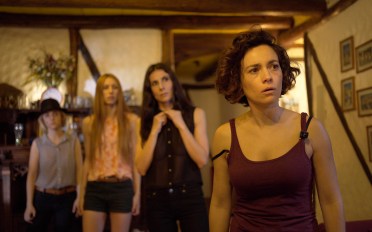 When viewing Trauma, it is important to have an understanding of where it’s inspiration comes from to truly appreciate what the film is trying to say. While the exact details of the story and the specific characters may not have actually occurred, the film is steeped in Chile’s modern history and very representative of a significant cultural issue that still impacts life today. In the real world, Chile’s democratically elected government was overthrown in 1973 in a brutal coup that resulted in Augusto Pinochet seizing power as the country’s iron-fisted dictator. During this period the country experienced an unfathomable amount of death and real world horror that left it irrevocably changed. This is important to know because at its core, this film is really about the country’s brutal and traumatic past still rearing it’s head in the modern world, and not simply another violent home invasion thriller.
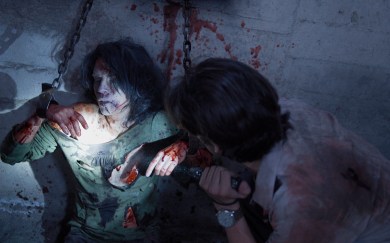 Another similarity between these films is the fact that they are all very well made, which is also what allows them to be so effectively disturbing. Writer/director Lucio A. Rojas has done an incredible job creating a living, breathing world thanks to gorgeous cinematography, top-notch gore effects, and realistic, believable characters. Speaking of characters, while I do want to make special note of the villainous perfection that Daniel Antivilo brings to his psychopathic character Juan, everyone across the board does an absolutely incredible job.
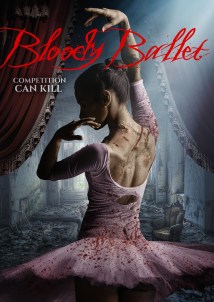 Bloody Ballet (aka Fantasma) certainly starts off promisingly enough. Snow falls heavily in the night sky as approaching police cars begin to illuminate the solitary figure of a young girl standing still, unmoved by the cold and completely unresponsive. The haunting score swells as the slow motion scene unfolds to reveal the bodies of her brutally murdered parents and I am officially hooked. Of course, it’s one thing to get the audience’s attention and quite another to actually hold it.
 Horror and Alternative Cinema Reviews