
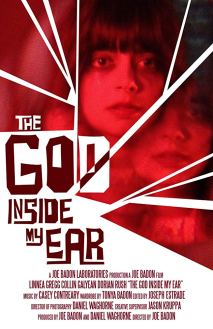
 Creating a surreal film that really works is an incredibly difficult feat. In the hands of masters like Lynch and Jodorowsky the final product can be a multilayered work of art with symbolism and subtext that will have people in spirited debate for decades. On the other end of the spectrum are the myriad of films that bombard the viewer with “weird for the sake of weird” imagery, with no inherent meaning or intent, and no subtle clues to decipher what’s going on until we are simply told. Any surreal film is bound to fall somewhere along this line and today we’re going to see how close to the top (or bottom) The God Inside My Ear ends up.
The film opens with a montage of strange, seemingly unconnected images, underscored by sinister music that culminates in two people in hazmat suits working on a dusty control panel in an abandoned looking room. After this, the movie is segmented into chapters and follows the story of Elizia (Linnea Gregg) who’s life begins to become more unhinged and surreal after she is suddenly dumped by her boyfriend.
The opening minutes of a film can reveal a lot about what you’re in for and one thing that stands out immediately about TGIME is how incredibly well shot it is. The image quality is rich and beautiful, the shots are well framed and artistic, and the use of disorienting video effects and colored lighting does an excellent job in creating a surreal, unstable feeling when needed. Writer/director Joe Badon certainly has a keen visual sense and there’s no question that the cinematography of this film is beyond reproach.
Of course, the look of a film is only one piece of the puzzle, as we also have to take into account the quality of acting and the backbone of the movie itself, the script. The results for the former are a bit varied as some actors deliver solid performances and others belie the professionalism of the footage quality with stilted, unnatural delivery. Although, to be fair, at timesit can be hard to tell how much responsibility can be attributed to the actors when so much of the dialogue is awkwardly constructed and full of attempts at comedy that fall completely flat.
TGIME starts to become a bit more interesting as it progresses, shifting tone from awkward “comedy” into surreal, light-horror. The main problem here is that the first act, which was supposed to create a baseline for the characters and their reality, is instead spent doing tired shtick that ultimately made me less invested in the outcome. Even so, TGIME does become more watchable as Elizia’s reality becomes more warped and viewers can expect to be treated to some well-constructed and delightfully bizarre imagery.
It should also be noted that this film does in fact have underlying meaning to the images and the reveal at the end sheds light on the story that preceded it, as well as make you think about the clues that were given along the way. However, while the reveal does serve to better explain what was happening, it also raises some very important practical questions that it leaves unanswered, which I can’t go into further detail about without spoiling the twist. What this all adds up to is a visually stunning film with an interesting (although not wholly original) concept and a script that could have been compelling with another rewrite, or three.

 Some Extreme Cinema films creep up on you slowly, holding back their edgiest material to sucker punch you with later on. Other films announce themselves right from the fucking beginning and, with a sexually explicit scene in the first two minutes, Portraits of Andrea Palmer wastes no time earning its Extreme Cinema cred. That’s not to say that one approach is better than the other however, as a “less is more” approach adds more punch to the shocking scenes you do have.
 The incredible advances in digital technology over the last few decades have made it more possible than ever for aspiring and indie filmmakers to make their vision a reality, or at least attempt to. Freed from the burdens and excessive cost that goes along with shooting on film stock, many indie directors will attempt to replicate the lavish production values of multi-million dollar films with elaborate DIY sets and numerous on-screen characters. This almost always results in a disastrous final product but is still a far more common practice than the more sensible approach of using a small cast and a primary central location.
 If you’ve only seen one film by the brilliant Japanese auteur Takashi Miike, then it was probably Audition. Not only is it Miike’s most well known film outside of Japan but it is also his most accessible. That’s not to say of course that it’s something that’s easily digested by the mindless masses, it is still a Miike film after all, and if it didn’t have some incredibly violent, disturbing scenes I wouldn’t be reviewing it here. Although, it’s not the violence alone that makes this film interesting, what really sets it apart is the brutal sucker-punch it gives the audience.
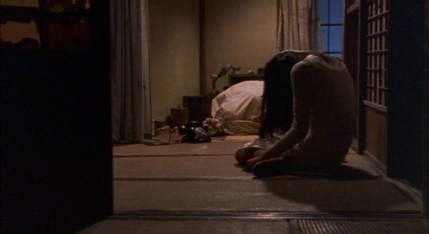 What really makes Audition work is that even with the tonal shift, the two halves of the film never feel like disparate ideas awkwardly stitched together but instead function as one cohesive story that is purposefully and methodically laid out. The dramatic, character-focused beginning fleshes out who these people are and makes the viewer truly invested in their fate. The fact that the violence is intense but used sparingly also gives it a far greater impact when it’s shown.
 To anyone who has taken so much as a cursory glance at my reviews it should be abundantly clear that I am an incredibly strong supporter of free speech. I’ve made it my mission to track down and review the darkest and most fucked up films ever made and I revel in witnessing cinema’s most disturbing creations. This is all to say that it’s extremely rare that I come across a film with parts that even I find problematic, but it does happen. A classic example would be the unsimulated animal killing in Cannibal Holocaust whose artistic value is superseded by the real world suffering caused by their creation. It had been a long time since I’d seen Murder Set Pieces, so I was surprised to find a similar moral predicament as I wondered to myself “Wait, is this a fucking pro-Nazi film?” More on that in a minute.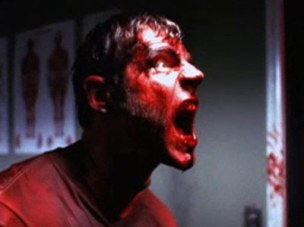
 However, this more generous read of the subject matter is a tough sell considering how the entire film feels like little more than a vicarious indulgence of Palumbo’s darkest fantasies.
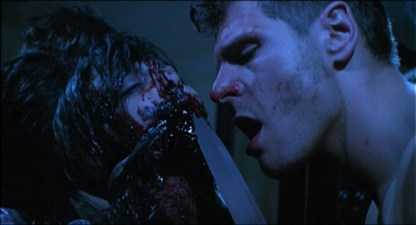 The chainsaw to the head scene stands out as a particular highlight but whether it’s a brutal throat slitting, bathtub drowning or vicious beating each violent scene is filled with a raw, vicious energy that makes the kills much more realistic and disturbing. Throw in some corpse eating, severed head fucking and a brutal on-screen child murder (!) and what you get is a truly unfiltered example of Extreme Cinema that goes well beyond where conventional horror films dare to venture.
 So, in the end there is a lot to like about MSP and if it hadn’t been infested with Nazi propaganda it would be an easy film to recommend to fans of hardcore cinema. Overall I’m left feeling conflicted because as much of a fan as I am of the gorgeous, unhinged violence I just can’t fully endorse a film that seems like it would be a top pick for a neo-Nazi movie night.
 The idea that alternate realities could simultaneously exist in the universe is certainly an interesting one and a concept that has become ever more pervasive in the popular consciousness of late.
 When determining how well a film works it’s important to first understand the type of film the director is trying to make and judge accordingly. Dreaming Purple Neon wasn’t released by Troma but given the copious amounts of low budget gore, nudity and general cheesiness, it’s something that could’ve fit right into their catalog. That is to say this is not a film that seeks to astound you with mesmerizing acting or a profound storyline but instead hopes to entertain with over-the-top visuals. This is a perfectly valid position for a film to take and one that is harder to successfully achieve than you’d think. So the real question becomes, does it pull it off?
 It wasn’t that long ago that horror anthology films were far less common than they are today. They never went away entirely of course but once the 90s rolled around they were pretty much relegated to cheap, straight-to-video cash grabs, most of which have been deservedly forgotten. That all changed with the success of modern anthology horror like Trick ‘r Treat and The ABCs of Death which revitalized a subsection of films that seemed destined for irrelevancy. As someone who is a big fan of anthology films, I couldn’t be happier with the unprecedented quality and abundance of these films today. Of course not all films are created equal and today we’ll see if The Forces of Horror Anthology feels more like a product of the modern anthology renaissance or a throwback to the dark days of the ’90s.
 It takes an unbelievable amount of work to make a feature length film and of course the longer your film, the more work it requires. This is why it’s unusual to see films venture past the standard ninety to a hundred five minute window, and downright rare for scrappy indie productions to attempt it. But this is exactly what writer/director (Jakob Bilinski) did with his ambitious and, uh, interestingly titled Three Tears on Bloodstained Flesh. Now, ambition is good, but it’s only half the battle so the real question here is, “how well does he pull it off?”
 Creating a film that inspires a genuine sense of dread and tension, with a small cast and limited locations, is no easy task. There is no sure-fire recipe for success with this, but there are two components that are required if a film is to have even a remote chance of working. The first is a genuine sense of realism, regardless of how fanciful the story, and the second is characters you can truly connect to as human beings so you are invested in their struggle. It sounds simple yet it’s amazing how rarely it’s pulled off effectively. So, does director Corin Hardy (great name btw) manage to succeed with his Irish folktale inspired film, The Hallow? Well, let’s discuss.
