
 If you’ve only seen one film by the brilliant Japanese auteur Takashi Miike, then it was probably Audition. Not only is it Miike’s most well known film outside of Japan but it is also his most accessible. That’s not to say of course that it’s something that’s easily digested by the mindless masses, it is still a Miike film after all, and if it didn’t have some incredibly violent, disturbing scenes I wouldn’t be reviewing it here. Although, it’s not the violence alone that makes this film interesting, what really sets it apart is the brutal sucker-punch it gives the audience.
After his wife dies of an illness, Shigeharu Aoyama (Ryo Ishibashi) must raise his son Shigehiko (Tetsu Sawaki) on his own. When Shigehiko becomes a teenager he begins to encourage his father to find a new wife and Shigeharu takes his advice to heart, in a rather unconventional way. By staging sham auditions for a movie that won’t be made, he is able to screen potential mates and quickly falls for one of the beautiful applicants, Asami (Eihi Shiina). But despite her sweet, meek demeanor, Asami is holding a very dark secret that threatens to unravel Shigeharu’s entire life.
Typically, when a film has a significant tonal shift, the end result is a story that feels unbalanced and poorly crafted. However, in this case, Miike uses that very concept to deliberately lull the viewer into a false sense of security before violently pulling the rug out from under them. The entire first half plays out as a well-acted relationship drama with no indication of the horrors that are in store. I can only hope that there are people out there who actually watched this expecting a drama and were scarred for life by what they witnessed in the final thirty minutes.
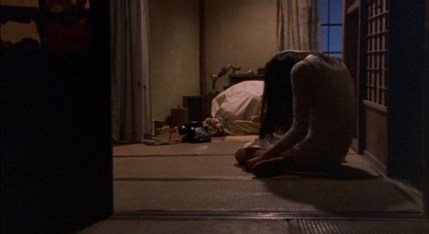 What really makes Audition work is that even with the tonal shift, the two halves of the film never feel like disparate ideas awkwardly stitched together but instead function as one cohesive story that is purposefully and methodically laid out. The dramatic, character-focused beginning fleshes out who these people are and makes the viewer truly invested in their fate. The fact that the violence is intense but used sparingly also gives it a far greater impact when it’s shown.
For the most part, the narrative of this film is quite straightforward and only really veers into surreal territory during a particular montage where a character seems to be aware of details he couldn’t have known without some kind of supernatural ability. It’s possible this may have been a slight oversight in terms of the perspective of the scene but it’s also possible that it was intended to be ambiguous and represent the character’s fears of what the potential truth might be. Either way, the scene plays out incredibly well with some gloriously grotesque imagery that will stick with you long after the credits roll.
As far as Miike films go, this one represents an essential entry into his canon and makes a great stepping stone for viewers into his more unhinged masterpieces such as Ichi the Killer and Visitor Q. It also serves as a cautionary tale that when relationships seem too good to be true, they usually are.

 To anyone who has taken so much as a cursory glance at my reviews it should be abundantly clear that I am an incredibly strong supporter of free speech. I’ve made it my mission to track down and review the darkest and most fucked up films ever made and I revel in witnessing cinema’s most disturbing creations. This is all to say that it’s extremely rare that I come across a film with parts that even I find problematic, but it does happen. A classic example would be the unsimulated animal killing in Cannibal Holocaust whose artistic value is superseded by the real world suffering caused by their creation. It had been a long time since I’d seen Murder Set Pieces, so I was surprised to find a similar moral predicament as I wondered to myself “Wait, is this a fucking pro-Nazi film?” More on that in a minute.
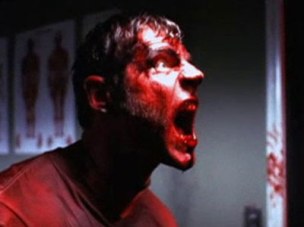
 However, this more generous read of the subject matter is a tough sell considering how the entire film feels like little more than a vicarious indulgence of Palumbo’s darkest fantasies.
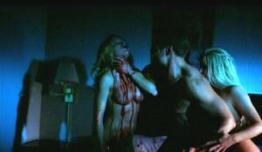
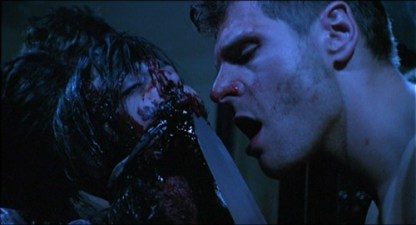 The chainsaw to the head scene stands out as a particular highlight but whether it’s a brutal throat slitting, bathtub drowning or vicious beating each violent scene is filled with a raw, vicious energy that makes the kills much more realistic and disturbing. Throw in some corpse eating, severed head fucking and a brutal on-screen child murder (!) and what you get is a truly unfiltered example of Extreme Cinema that goes well beyond where conventional horror films dare to venture.
 So, in the end there is a lot to like about MSP and if it hadn’t been infested with Nazi propaganda it would be an easy film to recommend to fans of hardcore cinema. Overall I’m left feeling conflicted because as much of a fan as I am of the gorgeous, unhinged violence I just can’t fully endorse a film that seems like it would be a top pick for a neo-Nazi movie night.

 The idea that alternate realities could simultaneously exist in the universe is certainly an interesting one and a concept that has become ever more pervasive in the popular consciousness of late.


