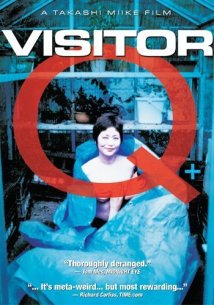
 Is it possible to have a film that features incest, necrophilia, rape and a whole lotta violence and still have it infused with genuinely heartfelt sentiment? If you’re maverick director Takashi Miike, the answer is abso-fucking-lutely! Just like other Extreme Cinema films like A Serbian Film or Irreversible, Visitor Q is not actually a horror movie but is an incredibly horrifying drama that goes way beyond the boundaries of most horror films in terms of content. So, how does all this shock value content actually marry with a sentimental core? Well, let’s discuss.
I do want to mention before I start, that while I’m not including spoilers, I do talk about quite a few plot points, so if you want to go in completely fresh, you’ll want to track down a copy and watch it first.
The story centers around the Yamazaki family who, it’s safe to say, has a couple of issues to work out. Patriarch Kiyoshi (Ken’ichi Endô) is obsessed with trying to create a documentary special for TV that takes an unflinching look at what’s really going on with Japanese teens today, especially in regards to bullying. His son Takuya (Jun Mutô) is the victim of severe bullying and takes his rage out on his mother Keiko (Shungiku Uchida) who in turn prostitutes herself to afford the heroin she needs to cope with the abuse. Kiyoshi’s teenage daughter Miki (Reiko Matsuo aka “Fujiko”) is a runaway turned to prostitution whom Kiyoshi interviews for his documentary in the opening scene of the film. After minimal convincing, Kiyoshi is soon fucking his own daughter, and that’s where this film starts. In the midst of all this extreme dysfunction, a mysterious man known only as The Visitor (Kazushi Watanabe) inserts himself into the family’s lives (after brutally attacking Kiyoshi with a rock several times) and begins to subtly influence them in surprising ways to achieve his goal.
What’s clear from the start, is that Miike set out to utterly shatter as many taboos as possible, which he does in a variety of bizarre, grotesque and extremely shocking ways. What’s perhaps most shocking to some, however, (although not surprising to fans of Miike’s work) is how well he is able to incorporate these extreme elements into a nuanced story about a disintegrating family unit. Rather than being gratuitous, the shocking scenes are an integral part of the story and work perfectly within the heightened reality of the world Miike has created.
Despite the fact that this film features a scene where a female character literally coats a room in a seemingly endless supply of her own breast milk, the part that struck me as most bizarre when I first saw it years ago, was the fact that people’s genitals are usually blurred out. Of course this has to do with Japan’s incomprehensible anti-obscenity law that allows graphic necrophilia, incest, and unsimulated oral sex, but draws the line at showing a flaccid penis. Being that Miike is known for pushing artistic boundaries and advocating for free speech, the extreme content in this film was no doubt a commentary on the ridiculous and arbitrary nature of censorship in Japan.
Overall, this is an incredibly interesting, engaging film with an unpredictable storyline that must be seen to be believed. For fans of Extreme Cinema this is an absolute must watch, especially if you enjoyed Miike’s more well-known films like Audition and Ichi the Killer. So gather your dysfunctional family around the TV and enjoy the most unique depiction of family dynamics you are ever going to see.

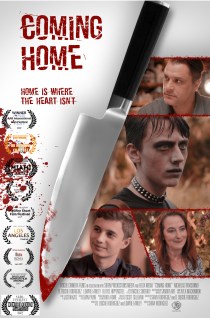 Even though it’s a tremendous amount of work creating a short film, it is undoubtedly a far more achievable task then attempting a feature, and a great way for indie filmmakers to hone their craft as they try to break into the business. Still, it comes with a unique set of challenges and being able to tell an interesting, concise, story in a very limited amount of time, is the most important (and difficult) of all. Given that most shorts are made independently, with very limited resources, there’s bound to be some rougher edges, but discerning audiences are willing to overlook such things as long as there is a compelling story at the core. So, does Coming Home have what it takes to be an indie short that’s worth your time? Well, lets discuss.
 The New French Extremity is the term used to describe a particular subset of films within the Extreme Cinema category, that were made by French directors around the start of the new millennium. Artforum critic James Quandt coined the phrase but, just as with the invention of David Edelstein’s term, Torture Porn, it was used in the pejorative sense. Regardless, both terms have been subsequently embraced by fans of boundary-pushing cinema, and it wasn’t long before the labels were worn like a badge of honor. Xavier Gens’ Frontier(s) is one of the most recognizable films of the French Extremity movement and certainly earns its stripes with graphic, visceral violence. But that aside, the real question becomes “how does it actually hold up as a film?” Well, let’s discuss.
 After successfully capturing the gruesome and dangerous feel of the original series with the first American Guinea Pig film, Bouquet of Guts and Gore, the primary challenge for the sequel becomes figuring out how to follow it up without being repetitive. It’s not surprising then, that Bloodshock would take the franchise in a pretty different direction from the first as it focuses on a male protagonist and is primarily shot in black and white. This is certainly a gamble, so the real question becomes, “does it pay off?” Well, let’s discuss.
 The Guinea Pig film series is celebrated by fans of Extreme Cinema for it’s uncompromising gore and sadistic violence that reaches levels so rarely able to be seen in film. Even though these films remain near and dear to the black hearts of us gore hounds, the fact is, that it’s been decades since the last film was released and at this point, the out-of-print DVDs are hard to even find. Although prior to the limited DVD release in 2002 by German company Devil Pictures, North American fans of the series only knew the films as grainy bootlegs from multi-generation VHS tapes.
 Horror movies are a great way to explore the feelings of anxiety and fear that are inescapable by-products of living in the insane fucking reality we all inhabit. Sometimes the fear represented is an intangible part of our subconscious and other times it is based upon violent and terrifying experiences from the real world. In the case of The Hitcher films, the fear is based upon the anxiety derived from bringing a total stranger into your car, or getting into theirs. In reality, numerous people on both sides of this interaction have met with deadly ends, so the effectiveness of these films is reliant in large part on how authentically they can represent that legitimate danger. A lot has changed in the twenty-one years between these movies but some dangers never lose their relevance, regardless of how many technical advances we make.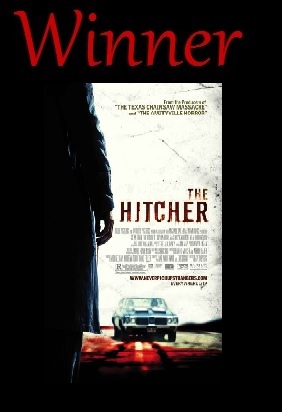
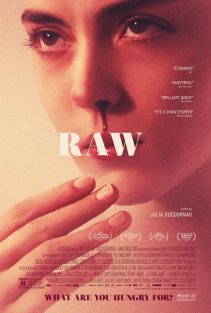 Sometimes the trailer for a film is so compelling and intriguing that you instantly know it’s a film you absolutely must see. For me, Raw was such a film and the dark, unusual, and clearly well-shot movie that was promised was one that I couldn’t wait to watch. Of course, a great trailer followed by months of waiting can certainly raise expectations for the film itself so the question is, did Raw live up to the hype and deliver on the high promise of the exquisitely made trailer? Well, lets discuss.
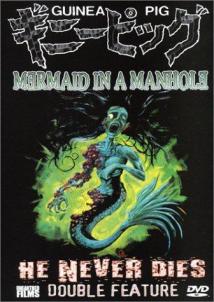 With this review I wrap up the original Guinea Pig series with the final (produced) entry, Mermaid in a Manhole. With the notable exception of the “comedic” outlier, Devil Doctor Woman, the series so far has ranged from solid to very good and set a high standard for Extreme Cinema that is rarely equaled to this day. So, does the final film live up to the expectations set by it’s predecessors or does the series fall flat at the finish line? Well, let’s discuss.
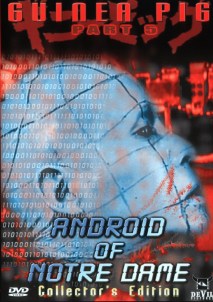 After achieving new heights of gloriously sadistic violence with the second installment, Flower of Flesh and Blood, the Guinea Pig series took a hard turn into comedy territory in the third (and especially) fourth entries, much to the detriment of the franchise. However, the fifth entry, Android of Notre Dame, drastically shifts the tone once again back to somber and serious. While this is certainly a welcome realignment of the series, the important question of how well the film itself works is still the primary factor. Now, a quick aside, I am, of course, aware that the fourth entry, Devil Doctor Woman was actually released after the other five but, since this is a retroactive review of the series, I am doing the films in the order they were produced rather than released.
 No matter the size of your film’s budget there are always challenges to face. Big studio pictures have nearly unlimited resources but the filmmakers must contend with meddling producers dumbing down their vision until it’s palatable to a wide enough audience. Conversely, indie filmmakers have the freedom to explore innovative ideas regardless of their marketability but face the challenge of attaining the resources to properly execute their vision. Despite this disparity, both indie and Hollywood films are fighting for the exact same prize, the limited time and attention of a finite number of viewers.