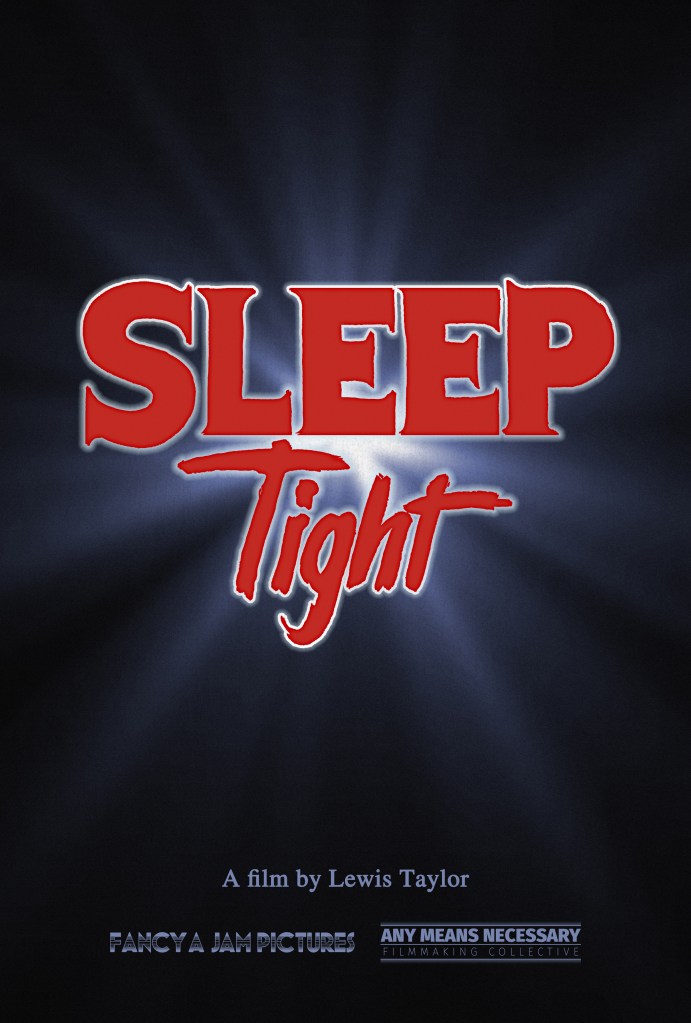
Horror and comedy so often go hand-in-hand but the key to executing the combination effectively is to ensure that its not just the jokes that land but the scares, too. Sleep Tight portrays a scenario that will no doubt strike a familiar chord with parents of adolescents as a father tries to get his teen son to turn off his video games and go to sleep. The tone is light but there is an inherent truth to the interaction as the father comes to grips with his maturing son, who in turn takes every opportunity to petulantly age-shame his father. When the horror does come, it’s the real deal and writer/director Lewis Taylor does a great job of not only building tension but also following through with well-crafted costume and effects.
There is a great sense of life and movement in the camerawork which is important, especially when confined to a single, small location. The humor isn’t exactly laugh out loud but it mostly works and I appreciated the subtler touches such as the posters in the background for films like Slenderman 2: The Slendering. The only part that really sticks out as a strange inconsistency is a particular shot involving the Necronomicon that feels bizarrely out of place in the world of the story and seems to be little more than a throw-away joke made at the expense of maintaining a cohesive reality. While it may not be perfect, Sleep Tight is still a fun, well-shot film that delivers on the horror and a damn fine way to spend eight minutes.
Availability: Upcoming Release
Film will be available to watch on YouTube on the Omeleto Horror channel starting 09/16/21.
When watching an experimental film it’s important to meet the movie on its own terms and view it through that lens. There seems to be a knee-jerk impulse in mainstream culture to immediately label films without a conventional narrative as nonsensical, images of violence as gratuitous, and unsimulated sex as pornographic. This kind of thinking is incredibly reductive and limiting, especially when art in other mediums such as paint and sculpture are more frequently praised as “bold” and “daring” for containing similar depictions. Artists should be free to use any item in their toolkit to make a creative expression that is genuine for them and true artistic freedom means anything and everything that happens between consenting adults must be allowed to be expressed. Art that pushes boundaries must be approached with an open mind and a strong stomach and it is with that mindset that I evaluate the unconventional, provocative collection that is Blood Tastes Like Perfume: The Short Films of White Gardenia.
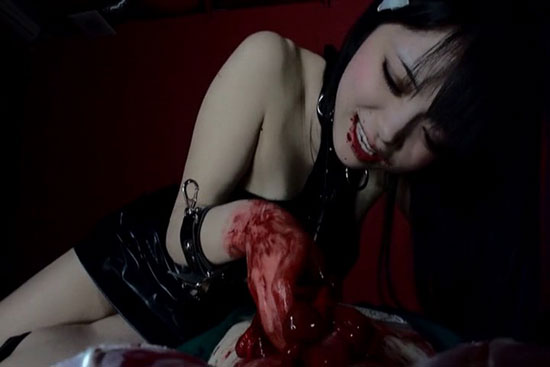
The band White Gardenia is headed by musician Daniel Valient and are well known in certain underground circles for their shocking fetishistic mutilation and blood drinking short films that are underscored with their original music. White Gardenia’s work primarily exists online but has been featured in some films that received a physical media release such as XXX: Dark Web and Vore Gore, both of which were put out by Tetro Video. Blood Tastes Like Perfume marks the first time the band has received a proper home video release on their own (this time courtesy of Bizarre Theatre) and the collection features eight of their videos including Blood is Sweeter than Honey, Akasha Drinking my Blood, and A Perfume Made From Blood and Tears.
The most pertinent question here is how well this collection works as a showcase for the work of White Gardenia. While this is by no means a complete collection of their work, the eight shorts do provide a solid representation of what White Gardenia is all about and gives viewers a glimpse into their twisted world. Still, I was a little disappointed by the omission of their most provocative film (and my personal favorite) A Midnite Snack which was one of the segments featured in XXX: Dark Web. What stuck out the most as a strange choice as far as the Blu-ray release itself goes however was the occasional references to additional White Gardenia videos online that appeared after some films. I understand the thought process here but the biggest problem with the execution (aside from sometimes neglecting to put in the web address) was that the text after one film advised that “full and uncensored” clips can be found online. Given the explicit nature of the scenes that are shown, the film is clearly not censored for content but that message seems to imply that some of the most interesting parts may be missing. Fans shelling out for a Blu-ray release like this should feel like they are getting the definitive collection, not a tease for more info that has to be found through a series of confusing links. It’s not clear at this point if there will be additional volumes released with more of White Gardenia’s output but if this is to be the only physical release then it is a glaring oversight to not include all the best, nastiest content in its full and uncensored glory.
Like any short film collection the quality varies from film to film as some are inevitably more compelling than others. The couple of bondage themed scenes that were included were actually the least interesting part of the collection as the scenes felt quite tepid and restrained for BDSM play and were further weakened by their juxtaposition to the far more intense scenes of real cutting and blood drinking. Even though it may have been a little repetitive I would have still preferred the inclusion of some of their other cutting and blood play videos in lieu of these to have a more cohesive and consistent experience.
Where this collection really shines is in its ability to showcase boundary-pushing art as Daniel and the rest of the performers go to extreme levels to create spectacle that is beyond the limits of what you will find in most films. Aesthetically, there are some strange choices such as including flubs and outtakes that could have been easily trimmed out but they do have a way of adding to the gritty, cinéma-vérité style of the production. The minimum production values of the scenes where shaky hand-held footage reveals genuine mutilation and blood drinking add to the dangerous, provocative feeling of voyeuristically consuming taboo acts that are shunned within mainstream society.
Another thing I really appreciate about this film is that it is far from simply being a collection of shocking content created to illicit a cheap reactionary response. There is a genuine surreal quality to the footage (especially when consumed all in one sitting) that make for an engaging and unique experience. This is thanks it large part to White Gardenia’s experimental and at times wonderfully discordant music and sound design that underscore most of the film. It is also due to some fantastic editing choices that heighten and enhance the scenes in very interesting ways. Probably my favorite moment occurred in Akasha Drinking my Blood when a constructed shot resulted in a scene so minimalist yet so perfectly unsettling that it felt straight out of Lynch’s Inland Empire. So, in the end while it’s not a perfect release, it is still a damn good one and will provide viewers with a unique experience that is provocative, unsettling and legitimately boundary-pushing.
Availability: Limited
Blu-rays can only be purchased through bizarretheater.com while supplies last. Not available to stream.
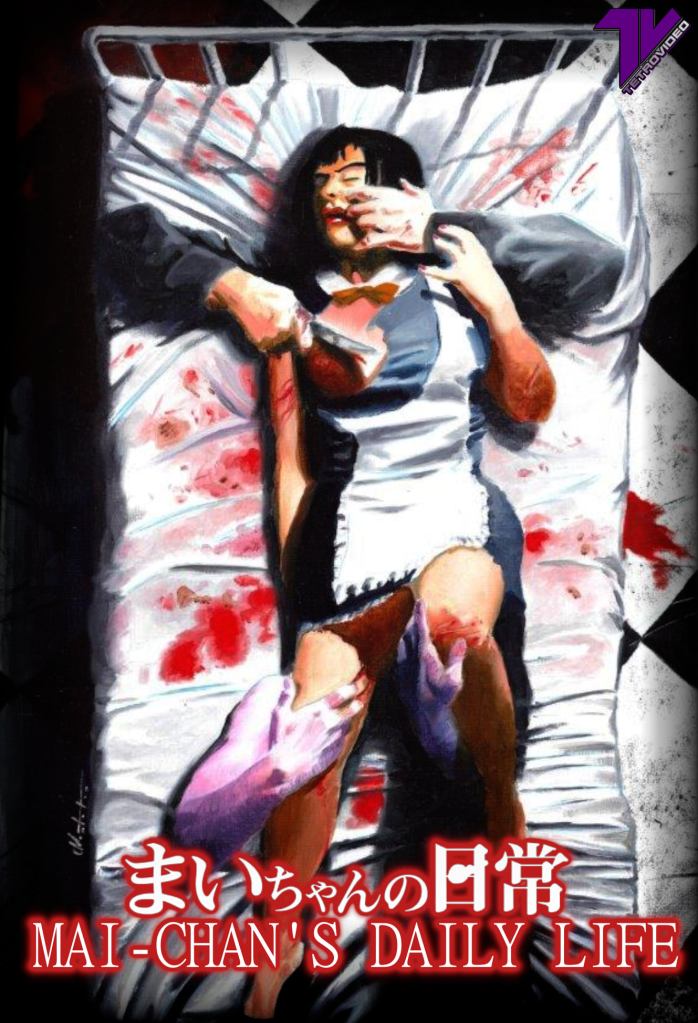
Mai-chan’s Daily Life brings to mind questions I never thought I’d ask such as “what if instead of being a badass superhero Wolverine was a tortured sex slave?” That’s essentially the central plot of this film, where a maid with infinitely regenerative powers (who can still feel pain) is used by her sadistic “master” to fulfill his violent, brutal fantasies. Loosely based upon the 2003 Manga Mai-chan no nichijô by Waita Uziga the film was adapted and directed by Sade Satô in 2014. While the story may deviate quite a bit from the source material, it maintains the same spirit of gleeful brutality thanks in large part to direct supervision of the process by Uziga himself.
The storyline in this adaptation centers around a new character created for the film named Miyako (Miyako Akane) who starts work as a maid at the remote house where Mai-chan (An Koshi) already works. Once Miyako dons her short, fetishistic maid outfit, Mai-chan starts showing her the ropes. This includes how to dust the jars filled with dead puppies, as well as how to be appropriately subservient to their wheelchair-bound employer known only as “Master” (Shôgo Maruyamawho) and the cruel head maid Kaede (Soako Roman). After witnessing the brutal punishment Mai-chan receives for daring to spill the milk that she was forced to lap up from a bowl on the floor, Miyako becomes aware of Mai-chan’s special ability. Rather than horrifying her, this seems to awaken something in Miyako who becomes obsessed with the idea of “devouring” Mai-chan.
Despite its incredibly brutal violence, the film actually feels toned-down from the Manga as it contains none of the graphic sex or (thankfully) pedophilia of the source material. I can’t say that there is really a lot beneath the surface here, as both the film and the Manga seem primarily created to indulge the Torture Porn fantasies of the audience and the lingering shots of bent-over maids and sadistic violence certainly work to support that idea. Don’t get me wrong though, there’s absolutely nothing wrong with that and it’s great when a film knows what it is and owns it. Despite all the violence, the film has a lightness to it and doesn’t take itself too seriously. There’s something about Mai-chan that just makes it so damn engaging (dare I say fun) and the experience is reminiscent of the similarly graphic yet lighthearted Guinea Pig 3: He Never Dies.
It helps that the acting and special effects are both excellent which serves to keep you immersed in this strange, twisted story. The film does (for some reason) alternate between black & white and color at seemingly random intervals which may have been an homage to the B&W source material, but I found to be a needless distraction. Even though it originally came out in 2014 the film is getting a proper re-release courtesy of Tetro Video in July of 2021, which is great news for fans who can no longer get a hold of the OOP edition that Redemption Films put out in 2016. Connoisseurs of twisted, splatter cinema would do well to check this one out because at just over an hour, it goes down real easy and has a great rewatchability factor. It may not be the most complex thing on the menu but it’s a satisfying treat that Extreme Cinema fans will want to devour over and over again.
A successful story is one that develops as it progresses, bringing new twists and revelations as it builds upon itself. When the story in question is a short, then it’s important that the movement occurs quickly and meaningfully. Director/co-writer Chris Guzzo finds that balance with Family Bond which starts out on a tense but innocuous domestic scene and develops into something far more menacing before long. Its difficult to really talk about the short’s plot without giving spoilers but there are other things to discuss. The acting for one is good, it’s not the best I’ve ever seen but it still manages to bring the characters to life and gets the job done. Within its brief run time the film is able to throw in some major twists and surprising revelations which is difficult to do within such a limited space. Those twists however do rely heavily on the acceptance of a certain fact that, while possible, is unlikely enough to remain dangerously close to implausible. Still, an overall interesting story that efficiently sets up the characters and the world and will take you on an engaging ride that builds to a fittingly dark climax.
Is it necessary to fully understand a film to enjoy and appreciate it? I would argue that it is not, for if that were the case surrealist masters like Jodorowsky and Lynch would never have ascended to their exalted levels within the film world. We still watch, discuss and are sometimes confounded by films like Holy Mountain and Eraserhead more than four decades later because there is far more beneath the strange visuals that bares fruit if we are patient enough to peel back the layers. Surreal films benefit from re-watching and further examination, the trick is to make your films good enough that its worth an audience’s time to do so.
Writer/director Chino Moya’s first feature is certainly a film that requires additional scrutiny to fully comprehend. While it’s not as overtly surreal as the previously mentioned films the slippery narrative thread and dream-like quality give it a viewing experience akin to Holy Motors with a healthy dose of High Rise mixed in. There aren’t exactly main characters nor is there a clear narrative through-line as segments seem to flow into each other, sometimes in the guise of stories told between characters, and occasionally intersect.
The structure in fact is more on par with a collection of short films taking place in a shared universe where the edges are muddied enough for them to meld into each other rather than all serving a common storyline. We see body collectors nonchalantly tossing corpses into their truck like they are common trash, a middle aged couple who’s frosty relationship threatens to become upended by an unexpected guest, a father telling his daughter a bedtime story of an unscrupulous merchant, a post-apocalyptic prison and an ordinary business man whose life becomes incalculably more complicated with the arrival of someone from the past.
Some of these segments flow very cleanly into each other, whereas at other times the connection is a bit more abstract. Regardless of their storyline similarities it’s really the emotional thread of dysfunctional relationships in a bleak and hopeless world that connects and links the stories. More importantly, the purpose of this film is not to provide a by-the-numbers plotline but to create an evocative experience where well-realized characters flow into each other’s worlds with a dream-like quality and in that regard it is better served by the unconventional structure. The result makes for an incredibly engaging experience whose shifting narrative works well to simulate the feeling of watching an unnerving dream (or more aptly a nightmare) unfold and giving the audience plenty to mull over between viewings.
Fortunately the beautifully bleak cinematography that deftly captures the quiet horror of a ruined city and the across the boards flawless acting make this a trip that’s worth taking multiple times. If you are looking for a straightforward, easily digestible story that neatly resolves then this is not going to be for you. On the other hand, those interested in taking on a cinematic experience that provides depth and layers of meaning to be gradually unraveled would do well to give this a try.
When The Blair Witch Project exploded onto the scene in 1999 it forever changed the world of horror cinema. In its wake, the once novel concept of a “found footage” film established by Cannibal Holocaust in 1980 quickly became ubiquitous within the market to the point of oversaturation. In the intervening years many filmmakers have used the audience’s willingness to embrace the rougher, naturalistic aesthetic of the style as an excuse for low production value as they churn out countless versions of the same basic story.
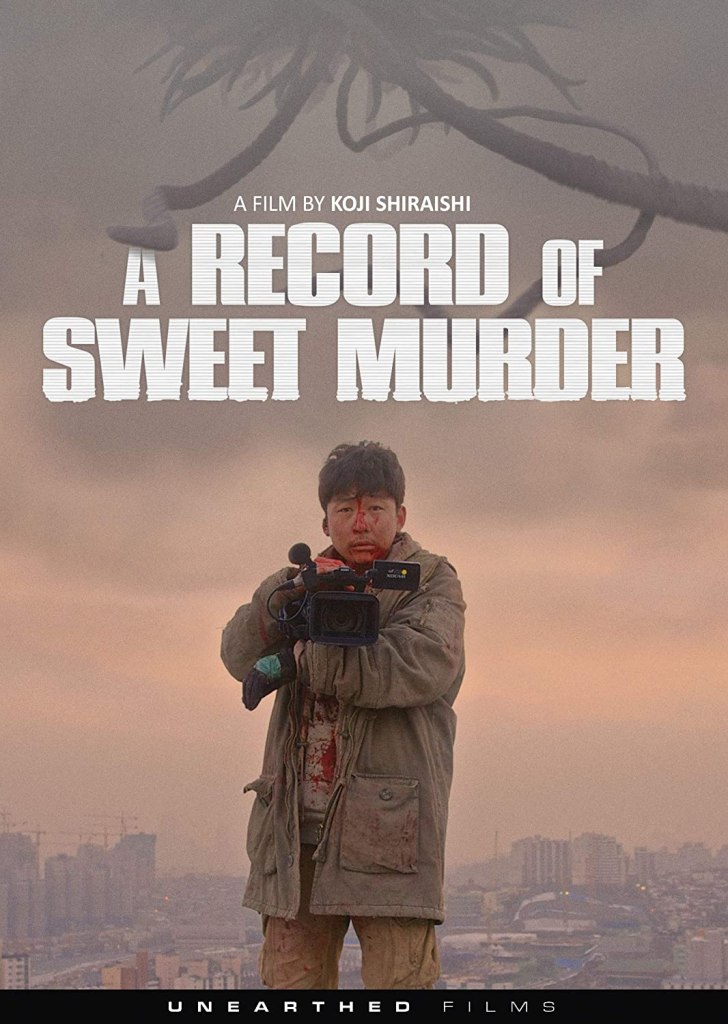
Thankfully, innovative filmmakers have also made their mark on the subgenre and films like Rec, Creep, and more recently Host (to name just a few) have elevated the style by taking it in new and creative directions. Innovation within the subgenre is rare enough but A Record of Sweet Murder is wholly unique as it dares to combine the found footage aesthetic with the rarest of cinema tropes, the single take film. By all conventional wisdom, an idea this ambitious could never work, but writer/director Kôji Shiraishi (Grotesque) pulls it off with results that are nothing short of mind-blowing!
The story centers around investigative reporter Kim Soyeon (Kim Kkobbi) who receives a call from Park Sangjoon (Je-wook Yeon), an escaped fugitive wanted for numerous murders. Park offers her an exclusive interview if she will meet him in a secluded location and bring along a Japanese cameraman. Since Kim and Park share a childhood connection, she believes that they will not be in any danger, but once they arrive it becomes clear that Park has a much larger plan in which they are to play an integral role.
To be clear, this film isn’t a true one-shot film like Russian Ark, but since everything but a few quick scenes at the end was done in a single take it’s still an incredible feat of filmmaking. It isn’t just the fact of doing it in a single take that is impressive, it’s what they are able to accomplish within the massive shot that is truly mind-blowing. Brutal fight scenes, multiple locations, numerous characters, realistic special effects, and an engaging storyline all work in concert to produce a thoroughly unique, mesmerizing experience. Even without the novelty of the single take this would be an incredible, well acted, and engaging film but the fact that Shiraishi goes the extra mile with a ground-breaking concept really puts it over the top.
It’s truly a cinematic travesty that such an innovative, brilliant film has gotten such little attention since its release yet Hitchcock’s faux one-shot film Rope is still talked about with such reverence after more than seven decades. I know that the cameras of the time limited the production to shooting it in a series of ten minute takes but Hitchcock’s blatant cutaways do absolutely nothing to preserve the illusion of an unbroken shot in that overrated “classic”. Despite this (and the fact that it felt more like watching a one-act play than a one-shot film) Rope was still innovative for its time and innovation should always be appreciated. To that end I’m hard pressed to think of many films in recent memory that have innovated more than ARoSM and here’s hoping that someday its style-blending brilliance will be appreciated for the unique achievement that it is.
I love horror anthology films and while we may not be getting as many these days as we did during the resurgence of their popularity in the early to mid 2010s, it’s good to see that they are still popping up occasionally. Typically these films will feature the collaboration of multiple directors and are a great way to showcase various talents within a single project. The structure allows the audience to be a little more forgiving of the overall film as stronger entries can sometimes redeem the goodwill lost by weaker ones. Ultimately though, the finished film is still a sum of its parts and today we’ll see if A Night of Horror: Nightmare Radio serves as a suitable distraction during these troubled times.

Every good anthology film needs a solid framing device to tie things together and in this case it comes in the form of a radio DJ named Rod (James Wright) telling scary stories during his show. There’s a good variety within the stories themselves as Rod spins tales of murder, revenge, and the supernatural. The cold open of the film shows a story of a vengeful ghost while the next deals with the very real and very creepy Victorian era practice of photographing the dead. Subsequent stories involve a sinister stylist, cruel and unusual prison punishment, a Spanish dancer with strange stomach pains, and a child who makes a frightening discovery in the kitchen. The final two stories involve a hunter with very unusual prey and a woman hearing odd noises while she is home alone. Rod’s story also follows its own arc and builds towards a satisfying and interesting twist that nicely caps off the preceding tales.
Fortunately there aren’t any entries that are simply bad but there are definitely some that are more successful than others. One of the standouts was the entry about the prisoner which managed to be morally complex and the degree to which viewers find it cathartic or disturbing is sure to vary depending on the person. Another highlight was the postmortem photography entry which had excellent structure and pacing, delivering a very complete, concise, and chilling story in just a few short minutes. I also want to give credit to the final story (and arguably scariest entry in the anthology) which does an incredible job expanding upon the unnerving sense of foreboding one can get while alone in their own house at night.
The only parts that don’t work here are a couple of times where the story didn’t quite come together as well as it should have. Unfortunately, the opening vignette suffers from this the most as the engaging visuals are undercut by a muddled story that fails to make any fucking sense whatsoever and seems more like a disparate collection of ideas than an actual narrative. Similarly, the hunter segment works well on its own but its introduction throws an unnecessary layer of confusion into the character motivations and inherent logic within the story itself.
These are ultimately minor quibbles though, because as a whole, Nightmare Radio is incredibly successful and every segment is exquisitely shot, well acted, and showcases brilliant special effects. This is definitely one to keep an eye out for and something that fans of horror anthologies will certainly want to tune into.
Sometimes just the fact that a film is in the horror genre tips you off that the plot is going to go in a certain direction. I mean, if a movie called The Dinner Party had everything go completely well for the characters the entire time you’d probably end up with a drama (and a damn boring one at that). So, while there is a certain amount of predictability and expectation within the basic structure itself, the real test of artistry is found in how well the filmmakers can finesse the details and create something original. Sometimes this means artists will take big swings with unusual concepts and plot twists, the end result of which is invariably a brilliant hit….or a spectacular miss.
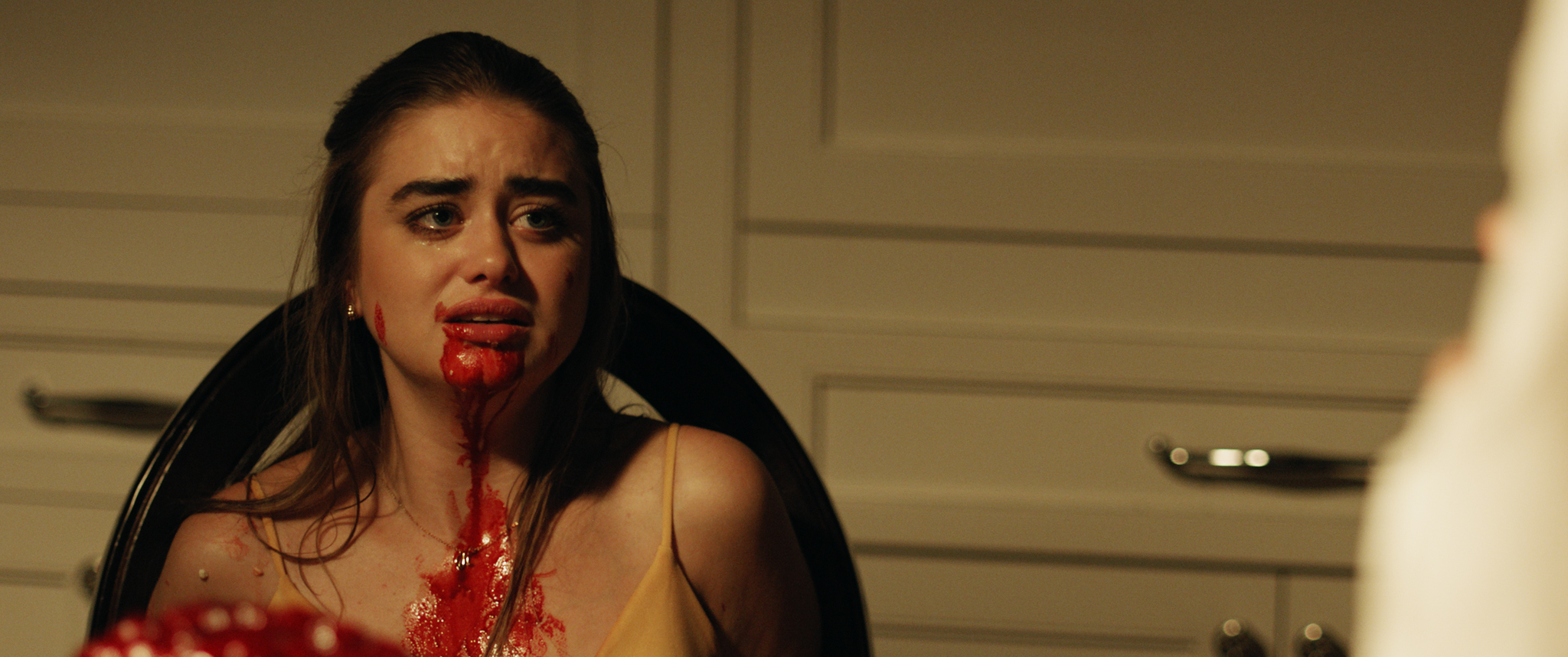

Small-time playwright Jeff (Mike Mayhall) seems to have gotten the opportunity of a lifetime when he is invited to a secret dinner party by a group of wealthy elites with enough pull to get his work onto Broadway. His wife Haley (Alli Hart) gets dragged along for the ride and before long the couple is bearing witness to the increasingly strange behavior of their wealthy hosts.
I always appreciate it when independent filmmakers are able to work well within their financial limitations and play to their strengths. Co-writer/director Miles Doleac (who also plays Vincent in the film) clearly understands this concept as he wisely keeps the action limited to one central location and utilizes a talented cast to bring life to the characters. Sawandi Wilson especially deserves to be recognized for his portrayal of the flamboyant and unhinged Sebastian which he imbues with a significant amount of subtly and depth.
The most welcome surprise for me however was just how depraved the film got at times, diving headlong into dark territory with cannibalism, necrophilia, and some scenes of gruesome violence. Doleac does an excellent job lulling the viewer into a false sense of security with warm, comfortable lighting and high-brow conversation right before violently yanking the rug out from under them. It’s a clever and subtle touch that mirrors the experience the characters are having and the solid acting across the board sells it perfectly.
A less successful gamble comes in the form of a third act twist (the details of which I won’t spoil) that severely erodes much of the good will the film had earned up until that point. It’s really unfortunate too because up until then I had really been enjoying the film. I mean sure there were lengthy discussions about opera that were as gratuitous as they were pretentious but this was still right on track for a four star rating. Not so once the “big revelation” slaps the audience across the face with a ridiculous concept that would be utterly eye-rolling in any film and feels exceptionally out of place here. You won’t have much time to dwell on it though because after that the film barrels toward the end credits, leaving in its wake a series of carelessly unanswered questions that put a nonsensical bow on an otherwise well made film.
Had this film simply carried along on the track it was already on for most of the runtime it would have ended up being a very solid horror experience punctuated with some great details and wry social commentary. Unfortunately, in its attempt to be entirely too clever for its own good, a mostly satisfying experience ultimately left me with a bad taste in my mouth.
Ever since The Blair Witch Project exploded onto the horror scene in 1999 and crushed the box office to the tune of a quarter billion dollars, countless filmmakers have tried their hand at tapping into that low cost Cinéma vérité style magic. Now that it’s 21 years later any filmmaker looking to utilize that format needs to bring something more to the table than abandoned footage found in the woods. Fortunately, M.O.M (Mother of Monsters) does bring an innovative twist to the standard formula as all the footage comes directly from cameras that characters use within the world of the film.
This approach alone isn’t unique but the justification and execution make it work better than most. Old home movie footage is spliced with straight to camera testimonials and consumer grade home surveillance as Abbey (Melinda Page Hamilton) obsessively documents the actions of her teenage son Jacob (Bailey Edwards). The more we see, the more it seems that this strung out single mother has good cause to worry as Jacob kills animals, has violent outbursts, and makes troubling maps of his school. Is Abbey uncovering the genesis of a dangerous criminal in the making…or is something else entirely going on?
Since the film devotes so much run-time to trying to make the viewer wonder about Jacob’s true motivations, it’s unfortunate that an early scene on an overpass heavily tips the scales, clearly showing which character is capable of committing unrepentant acts of violence. While the scene itself is well done, the film would be far stronger without it and would allow for some actual ambiguity throughout the story. It’s a shame too since the novel approach actually does effectively make use of the found footage conceit in a way that is modern, innovative and justified (mostly) within the world of the film. It also maintains a storyline that does drag a bit in places but overall manages to be engaging and at times all too real.
M.O.M’s true strength however is with its actors, which is fortunate as this is pretty much a two-hander between mother and son. The acting (and I cannot overstate this) is fucking incredible! Hamilton and Edwards truly live inside their characters and their pitch-perfect depiction is what makes the film work. The nuance and subtlety that they bring to their roles make this prescient story about a young man potentially going down a violent path feel even more dangerous and real. In a world where senseless acts of violence are commonplace, a film that reflects the anxiety that the true monsters can be found within the people we are closest to is a very scary concept indeed.
As anyone who follows me on Twitter knows, it’s my mission to track down and review the most fucked up films ever made. Because of this, my idea of what truly constitutes Extreme Cinema may be a bit …..different than many people’s so I’m always at least a little skeptical when filmmakers contact me out of the blue and claim that their film is shocking and edgy. Still, I went into 29 Needles deliberately knowing nothing about it and keeping an open mind. Within the first few minutes one thing became perfectly clear, this is one film that DEFINITELY belongs in the Extreme Cinema category!
The story follows Francis Bacon (Brooke Berry), a troubled man who uses alcohol and pain to help abate the symptoms of his inner turmoil. He is beginning to lose hope as his self-destructive coping mechanisms are becoming less effective and his strange hallucinations more prevalent. When a mysterious young man named Hans (Jamee Nicholson) offers him an invitation to secret society where there are no sexual limits it may be the cure he’s looking for….or the beginning of a whole new nightmare.
One thing viewers should know going into this is that it’s the very definition of “not for everyone” and if copious amounts of unsimulated gay sex is too much for you to handle then this is probably not going to be your particular brand of vodka. However, for Extreme Cinema fans without such hangups this proves to be an interesting and unique ride into some very dark and depraved territory.
My favorite thing about this film and something that is unequivocally true is that it does NOT hold back. 29 Needles is a great example of raw, unfiltered cinematic expression that gives zero fucks about appealing to a mainstream crowd or worrying about who’s offended in the process. Rape, mutilation, watersports and bloodplay are all on full display here as well as fetishistic acts that even I had never seen before (I have two words for you, eyeball tube). Writer/director Scott Philip Goergens clearly has a vision and takes a punk rock, no holds barred approach to executing it.
So, clearly the film has balls, ones that it’s not afraid to literally skewer with needles, but there’s still the question of how well it’s made. On that front it’s a little bit of a mixed bag as it does fall pray to some of the common shortcomings of indie films such as a flat, digital image quality and some supporting actors whose performances fall well short of convincing. However Berry more than makes up for this with his fully committed, method performance that is absolutely mesmerizing to watch. There is also some great practical effects work in the form of a giant sentient cock that looks straight out of Cronenberg’s golden era.
Ultimately this film is an endurance test of shock and depravity and one that real fans of genuinely edgy cinema won’t want to miss. An interesting and engaging plunge into darkness that’s completely fucked up, in the best possible way.