
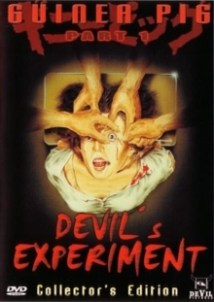
 Horror fans familiar with the notorious Guinea Pig film series will most likely remember them as “those fucked up faux snuff bootleg tapes” that circulated through underground horror communities in the ’80s and ’90s, much like the Faces of Death films. Even now, the original series is very hard to come by and fans of underground horror will need to be prepared to spend hundreds of dollars on the out-of-print box set, if they can find it at all. But find them I did, because no list of the most extreme horror films could possibly be complete without them. I also wanted to see how these films held up in the age of modern Torture Porn and if there was a greater value to them beyond the shock factor.
The first film in the series, Guinea Pig: Devil’s Experiment has a “plot” that can be easily summarized as “three men torture a woman for forty-three minutes.” However, it would be a mistake to simply write this film off as a misogynistic torture fantasy because there is a lot more to unpack about it than initially meets the eye.
First of all, this is an experimental film and should be viewed as such. The plot itself is not as much of a relevant factor in this case, since the experience is more about the provocative imagery and a visual representation of raw human cruelty and suffering. What’s more relevant is whether or not the film holds the viewer’s attention. In this case, despite the absence of a conventional plot and defined characters, it manages to keep you engrossed and curious to see what comes next as the violence increases in intensity.
A good storyline is an essential component to making a quality film so without that, a movie can’t achieve true greatness, no matter how interesting the visuals are. However, there is certainly something to be said for a film that strips away all pretense of story and presents the raw horror of brutality that is the primary draw for the fans to begin with.
Also, within those visuals, there are a lot of interesting and innovative techniques that are applied. For instance, the use of sound as a torture device, as they strap headphones on her and subject her to 20 hours of blaring noise, enough to drive any normal person absolutely insane. It’s an interesting idea and one that hasn’t been utilized very often since, despite the plethora of creative torture that’s been featured in countless films since. The hot oil scalding and hand crushing are also worth noting but the real standout is the needle through the eye, a ghastly and brilliantly executed effect that still holds up decades later.
All this aside though, what really makes Devil’s Experiment significant is how pioneering it was and it’s substantial contributions to the genre as a whole. A primary example of this is how the film is bookended with text telling the viewer that this is a “private video” the unknown writer of the narration obtained and that the info about the people involved is “missing”. Certainly not the first example of a “found footage” film but definitely a very early and influential example that would help pave the way for an entire subgenre some years later.
It’s also interesting to note that the tactic actually worked a little too well and producer Hideshi Hino had to prove to authorities that no one was actually hurt during the making of the film, just as Ruggero Deodato had to do with Cannibal Holocaust a few years earlier.
Another significant contribution is that this film was one the earliest, if not the earliest, examples of a Torture Porn film, despite the fact that the actual term wouldn’t be officially coined for another twenty-one years. So, regardless of how well the film overall holds up, there is no denying its important influence on not one but two subgenres of horror.
Despite it’s historical significance, I do have to concede that the overall watchability of the film isn’t terribly high and many of the less remarkable scenes do drag on a bit with little to hold your interest. Not to say there isn’t enough there overall to keep you watching, but that doesn’t mean you won’t be checking your watch during some scenes, especially towards the beginning. Regardless, this is undoubtedly a film worth tracking down, not just for the couple of scenes of effective gore but also to witness a piece of underground horror history for yourself.

 Today I drink up Happy Hour, the twisted debut short from director Gavin Thompson. Does this dialogue-free, black and white film have what it takes to deliver a compelling story in under twelve minutes? Well, let’s discuss.

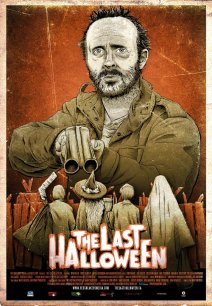 It is still a bit early yet to think about but, believe it or not, Halloween is right around the corner. In the spirit of that horror-themed holiday which is so near and dear to our black hearts, I decided to review the 2013 short The Last Halloween.

 With this review I conclude my current binge of Richard Powell shorts with his 2012 film Familiar, which was made between his shorts Worm and Heir. After seeing the caliber of his other films I was very intrigued to see how this one would stack up to the others and if he could in fact maintain the high level of quality I’ve come to expect from his films.

 For this review I once again go into the dark mind of Richard Powell and dissect his 2010 short, Worm. After giving out one of my very rare five star ratings to his 2015 short Heir I was certainly interested to see how his other work compared. Does it stand on equal footing with the later film or is there a progression to the quality of his films that culminates in the outstanding 2015 film? Well, let’s discuss. By the way, some aspects of the ending are referenced here, not a full on reveal of course but all the same I feel a spoiler alert is warranted for this review just in case.

 I see the format of short films in general as an opportunity for truly unbridled filmmaking. Even though the filmmakers themselves almost never see much in the way of financial gains from the actual shorts, they are also not beholden to the kinds of artistic compromises so often required to make a feature film marketable. This allows the most daring and talented directors to create short films that delve into dark subject matter and employ experimental techniques to create a vision untarnished by the meddling of outside forces who seek to make it more “palatable” for a wider audience. Directors who take advantage of that freedom are sometimes able to create films that are uninhibited, brilliant art pieces and Heir is one such film.

 When your film has a running time of under ten minutes there isn’t a lot of room to flesh out an elaborate story and the entirety of the film is generally focused on the resolution of one central conflict. Stained is no exception to this rule, and the plot can easily be summed up as (sigh)…..a man takes a shit and has to try and find some toilet paper to wipe his ass. Yes, that’s really the plot.
 As you can imagine, I’ve seen a lot of films in my day and always enjoy seeking out the most bizarre, abstract and downright weird films I can find. I can safely say however that I have never seen a film, especially a short, that starts with a guided meditation (!). But that’s exactly what happens at the beginning of Feed the Black, the viewer is instructed to close their eyes and empty their mind while a voice-over prattles on for almost five full minutes! That’s a significant chunk of time when the total running time is only about thirty-two minutes. If the V.O. contained important plot information or tied back into the film at a later point this could perhaps have been justified but as it is it feels incredibly extraneous.


