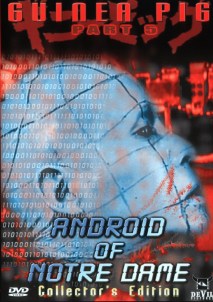
Guinea Pig 5: Android of Notre Dame (1988)

GP5After achieving new heights of gloriously sadistic violence with the second installment, Flower of Flesh and Blood, the Guinea Pig series took a hard turn into comedy territory in the third (and especially) fourth entries, much to the detriment of the franchise. However, the fifth entry, Android of Notre Dame, drastically shifts the tone once again back to somber and serious. While this is certainly a welcome realignment of the series, the important question of how well the film itself works is still the primary factor. Now, a quick aside, I am, of course, aware that the fourth entry, Devil Doctor Woman was actually released after the other five but, since this is a retroactive review of the series, I am doing the films in the order they were produced rather than released.
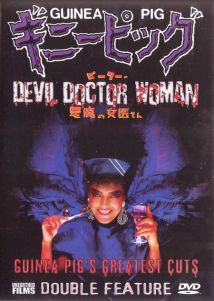
Counter to early entries that were very light on actual plot, this installment represents the first time in the series that an attempt is made to incorporate a storyline that’s really grounded in a dramatic, character-driven plot. Said plot centers around Dr. Karazawa, a diminutive scientist who performs highly unethical human experiments in his basement lab, desperately trying to find a cure for his dying sister. Seemingly out a nowhere, a mysterious man named Kato, who knows all the details of the doctor’s experiments, calls him up and offers a business deal to help with the research. Karazawa begrudgingly accepts but it isn’t long before Kato shows up in person and reveals his true motivation for contacting the doctor.

Overall, the story works quite well and provides seriously portrayed characters with complex motivations that aren’t simply playing for gross-out laughs as in the previous two films. Still, viewers expecting the faux-snuff experience of the first two entries that gets right to the point with the brutality may be dissapointed with the occasional slow pace of this film.

This is a story worth sticking with though, because it’s not long before the plot veers into the kind of glorious insanity that makes extreme Japanese cinema so much fun in the first place. By incorporating sci-fi elements like a living severed head, robotic arms, and corpse resurrection, Android takes the series in a wonderfully weird direction. My only real complaint here is the wraparound plot with Karazawa as an old man that doesn’t tie very well to the actual story and could have simply been cut without being missed.

Since this is a Guinea Pig film, fans come in expecting a certain level of graphic violence and on that, Android delivers quite nicely. That being said, there are times when the illusion is betrayed by some inexplicably cheap looking effects, but there are enough well-executed, extremely gruesome shots to make up for it. Eyeballs are pulled out with the optic nerve still attached, ribs are broken off one by one, and organs graphically ripped out just to name a few.

Overall this film has some imperfections but in the end, gets the series back on track by delivering the dark tone and obscenely graphic violence that we expect from a proper Guinea Pig film.

3-5-stars-red

Guinea Pig 4: Devil Doctor Woman (1986)

Guinea Pig 4While Guinea Pig 3 tested the waters by branching out in a more comedic direction, the 4th installment, Devil Doctor Woman, jumps in with both feet, taking the series from horror to full-blown slapstick comedy. It still manages to be violent and disturbing but the tone is the absolute polar opposite of the first two, so different in fact that it is baffling that it could even be considered part of the same series. So, does this even more extreme tonal shake-up still manage to deliver the kind of satisfyingly gruesome experience we’ve come to know and love from these films? Well, let’s discuss.

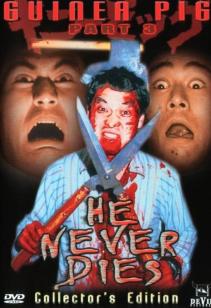
The film is essentially just a series of bizarre sketch comedy shorts that center around the unlicensed transvestite “doctor” known as the Devil Doctor Woman. There isn’t an overarching plot to speak of, just a series of nine disconnected segments with the only commonality being the presence of the Doctor or her alter ego, the Cleaning Lady. The segments themselves typically involve the Doctor introducing patients who are suffering from outlandish afflictions and attempting to cure them in weird, violent ways.

It isn’t really worth delving into the writing as nothing about this film is taken seriously and every segment is merely created for the purpose of eliciting gross-out laughs. Although, I’m not sure who’s laughing, because each of the witless segments provides little more than gags about body functions that feel like they were written by demented twelve-year-olds. Now, I’m all for fucked up comedy, but I do have the crazy requirement that it actually be funny and not just incredibly irritating.

One of the main things that made the previous Guinea Pig entries work so well, was the highly detailed, shockingly realistic violence. In this case though, the only thing shocking is how cheap and poorly crafted the special effects look. Heads explode on obvious mannequins, bad make-up reveals bald caps and the less said about the cheap Halloween prop with the floppy rubber spikes the better.

All that being said, though, there were some, but not many, positive aspects of this film. For instance, the segment involving the “Tasting Party of Human Flesh” was a brief highlight that made the film feel at least somewhat connected to previous entries. The idea of a posh gathering where people sample grotesque dishes like Cancerous Liver Curry and Severed Vagina in Blood Sauce at least show a level of gruesome creativity, despite the fact that the props still look like they were bought at a discount costume shop. There also is potential to the concepts in many of the segments, but poor execution and the baffling reliance on the over the top “comedy” completely sabotage them.

Overall, a poorly conceived concept and a baffling direction to take the film series in. The first three entries are well worth watching but new fans of the series would be better off skipping this one entirely. Just like the fourth season of Arrested Development this entry adds nothing of real value and only taints the memory of the three fantastic installments that came before it.

1-star-red

Guinea Pig 3: He Never Dies (1986)

GP3 He Never DiesFor its third entry, the Guinea Pig series goes in a very different direction with He Never Dies. Instead of the somber, grueling brutality of the first two, this film adopts a lighter, comedic tone. In fact, rather than classifying this entry as true horror, it would be more accurate to describe this installment as a black comedy, albeit an exceptionally violent one. So, does this incredibly risky stylistic shake-up actually work in a series known for realistic Snuff impersonation? Well, let’s discuss.
In addition to the change in tone, this is also the first entry to really use a conventional plot structure with clearly defined character motivation and a traditional story arc. At the center of that story is Hideshi (Masahiro Satô), a depressed office drone who just can’t catch a break. When he decides he’s finally had enough and cuts his wrist, he makes the shocking discovery that not only can he no longer feel pain…..he can’t die at all. Although initially distraught, he soon comes to the realization that he can use his new found powers to terrorize a coworker he’s jealous of. I know, hilarious, right?

So, while that may not sound at all like something that even resembles comedy, the story itself is portrayed with a goofy, over-the-top and undeniably comedic tone. Because this is such a jarring change from the previous films, it is best not to try and draw comparisons between them and simply view this as a stand-alone entry. Regardless, even at forty minutes, it still manages to feel long at times and you may spend the first quarter of it asking yourself “How the fuck is this a Guinea Pig film!?” Patient viewers will be rewarded though, because once it starts gaining momentum, it unleashes the well-crafted, gruesome effects the series is famous for.

Initially, I myself was very skeptical of the idea of a comedic entry in the Guinea Pig series, but since the first two films have such scant plotting and no overarching story to connect them, simply showing women getting tortured over and over again in the sequels would create stale, diminishing returns. In this case, things weren’t just changed, they were flipped 180 degrees. Rather than a somber, anti-plot structure showing violence inflicted upon women, it gives the viewer a comedic, classically structured film where a man inflicts violence upon himself.

So, while it may not deliver the traditional Guinea Pig experience, this is a bizarre piece of hyper-violent absurdist comedy that is surprisingly enjoyable and well worth the very minimal time investment.

3-stars-red

Guinea Pig 2: Flower of Flesh and Blood (1985)

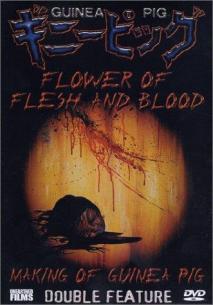
GP2 Flower of Flesh and BloodThe Devil’s Experiment may have kicked off the Guinea Pig series but the second installment, Flower of Flesh and Blood, is where it really starts to come into it’s own, providing a far more gruesome and brutal entry. It also gained significant notoriety in the states back in 1991 when Charlie Sheen (yes the Charlie Sheen) saw it, was convinced it was a real snuff film and reported it to the FBI. As laughable as this may seem, it’s not completely without merit, as the lack of story and hyper-detailed gore was specifically crafted to give the viewer the impression they are witnessing a real crime. Additionally, the film does start with text stating that the movie was actually a recreation of a genuine snuff film that writer/director Hideshi Hino had received from a crazed fan of his Manga work.
This story became the stuff of urban legend for years and Hino did become the subject of a police investigation because of his work. But despite what some persistent rumors claim, he never actually had to appear in court because of it and revealed years later in a Vice interview that the part about receiving an actual snuff film was a complete fabrication. So, notoriety aside, how does Flower of Flesh and Blood actually hold up as a film? Well, let’s discuss.

Much like Devil’s Experiment, this entry is also light on plot but does actually have a clear narrative structure. It starts with an unidentified woman being chloroformed and kidnapped as she walks alone at night, later waking up tied to a table in a windowless room where torture implements lie about. Her white-faced, Samurai helmet-wearing assailant quickly gives her a mysterious drug that will “turn her pain into ecstasy” before graphically disassembling her body with his crude torture implements. I won’t reveal too many details about what plot there is but suffice to say it does come to a thematically satisfying conclusion that also leaves the door open for a continuation of the twisted story.

The entire film may only be forty-two minutes but packed within that is more gore than you’ll see in many feature-length horror movies. It also achieves a level of graphic brutality that goes far beyond what most other films have the balls to portray and even thirty-two years later, the special effects still look amazingly real. This is largely due to the fact that Hino goes into great detail to show how slow and laborious the process of taking apart a body actually is. This is a level of detail that is often skimmed over in films but as anyone who’s broken down a chicken before knows, it takes a significant amount of effort to cut through bones and joints.

There are also numerous aspects beyond just the gore itself that make this film a very disturbing experience. For one, seeing a person who’s awake but not crying out in pain while someone mutilates their body is actually more disturbing in a way and is incredibly unsettling and surreal. There is also the scene where the white-faced Samurai shows off his “collection” of maggot-infested body parts while an eerie voice recites a poem about Hell in the background. It’s a simple and strange effect that works incredibly well to enhance the disturbing, surreal experience of the film.

The disc from Unearthed Films also includes a making-of featurette which is very interesting to watch after the film. Not only does it show the level of detail that went into crafting the amazing effects but also has outtakes showing the cast and crew joking around and bursting into laughter in-between takes. That itself is perhaps the most surreal part of the entire experience. All in all, a classic piece of horror cinema that’s worthy of it’s cult status and belongs in the collection of any serious gore hound.

4-stars-red

Guinea Pig: Devil’s Experiment (1985)

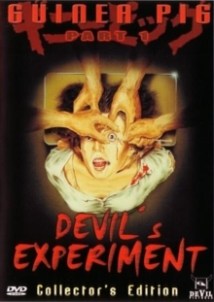
GP1 Devil's ExperimentHorror fans familiar with the notorious Guinea Pig film series will most likely remember them as “those fucked up faux snuff bootleg tapes” that circulated through underground horror communities in the ’80s and ’90s, much like the Faces of Death films. Even now, the original series is very hard to come by and fans of underground horror will need to be prepared to spend hundreds of dollars on the out-of-print box set, if they can find it at all. But find them I did, because no list of the most extreme horror films could possibly be complete without them. I also wanted to see how these films held up in the age of modern Torture Porn and if there was a greater value to them beyond the shock factor.

The first film in the series, Guinea Pig: Devil’s Experiment has a “plot” that can be easily summarized as “three men torture a woman for forty-three minutes.” However, it would be a mistake to simply write this film off as a misogynistic torture fantasy because there is a lot more to unpack about it than initially meets the eye.

First of all, this is an experimental film and should be viewed as such. The plot itself is not as much of a relevant factor in this case, since the experience is more about the provocative imagery and a visual representation of raw human cruelty and suffering. What’s more relevant is whether or not the film holds the viewer’s attention. In this case, despite the absence of a conventional plot and defined characters, it manages to keep you engrossed and curious to see what comes next as the violence increases in intensity.

A good storyline is an essential component to making a quality film so without that, a movie can’t achieve true greatness, no matter how interesting the visuals are. However, there is certainly something to be said for a film that strips away all pretense of story and presents the raw horror of brutality that is the primary draw for the fans to begin with.

Also, within those visuals, there are a lot of interesting and innovative techniques that are applied. For instance, the use of sound as a torture device, as they strap headphones on her and subject her to 20 hours of blaring noise, enough to drive any normal person absolutely insane. It’s an interesting idea and one that hasn’t been utilized very often since, despite the plethora of creative torture that’s been featured in countless films since. The hot oil scalding and hand crushing are also worth noting but the real standout is the needle through the eye, a ghastly and brilliantly executed effect that still holds up decades later.

All this aside though, what really makes Devil’s Experiment significant is how pioneering it was and it’s substantial contributions to the genre as a whole. A primary example of this is how the film is bookended with text telling the viewer that this is a “private video” the unknown writer of the narration obtained and that the info about the people involved is “missing”. Certainly not the first example of a “found footage” film but definitely a very early and influential example that would help pave the way for an entire subgenre some years later.

It’s also interesting to note that the tactic actually worked a little too well and producer Hideshi Hino had to prove to authorities that no one was actually hurt during the making of the film, just as Ruggero Deodato had to do with Cannibal Holocaust a few years earlier.

Another significant contribution is that this film was one the earliest, if not the earliest, examples of a Torture Porn film, despite the fact that the actual term wouldn’t be officially coined for another twenty-one years. So, regardless of how well the film overall holds up, there is no denying its important influence on not one but two subgenres of horror.

Despite it’s historical significance, I do have to concede that the overall watchability of the film isn’t terribly high and many of the less remarkable scenes do drag on a bit with little to hold your interest. Not to say there isn’t enough there overall to keep you watching, but that doesn’t mean you won’t be checking your watch during some scenes, especially towards the beginning. Regardless, this is undoubtedly a film worth tracking down, not just for the couple of scenes of effective gore but also to witness a piece of underground horror history for yourself.

3-stars-red

Short Film Review: Happy Hour (2016) Duration: 11 min 48 sec

happy-hour1Today I drink up Happy Hour, the twisted debut short from director Gavin Thompson. Does this dialogue-free, black and white film have what it takes to deliver a compelling story in under twelve minutes? Well, let’s discuss.
The film follows two nameless characters, a young woman (Melanie Jess) who is bringing a young man (David Kim) back to her apartment. However, what appears at first to be a standard night of hooking up takes a turn for the brutal as it becomes clear she has something far more sinister in mind.

The first thing that is of note about this film is that in addition to being black and white it is also utterly without sound other than the boisterous classical music that plays throughout. These are both very bold stylistic choices that can make films come off as incredibly pretentious if not handled correctly. For these choices to work there needs to be a solid thematic reason for choosing them over conventional methods of telling the story otherwise it becomes counter-productive.

I feel like a lot of aspiring filmmakers use B&W in an attempt to emulate the classic notion of indie cinema but what they should know is that those films were primarily shot on B&W stock for practical reasons rather than artistic ones. While Happy Hour does look good in B&W I am unconvinced that it (as well as the music) was used for any other purpose than to try to impose a greater artistic significance on the story. If the story had been complex and nuanced these choices may have carried more weight but as it is it’s very one-note. It (and I feel a spoiler alert is warranted here) gets on one track and stays there without adding any twists, reversals or surprises. The classical music also had a bit of a muting effect on the violence and would have served the film better had it only played during select parts or been turned down so that the screams and sound effects could come through.

I do want to point out though that despite these issues there are also some key things that the film does very well. The actors for one are able to express an incredible amount with only their facial expressions and body language. Both turn in very solid performances but Jess really shines in this regard, allowing her subtle facial expressions to communicate the malevolent feelings underneath.

In addition, the special effects are simple but effective and Thompson wisely chose to stick with gore gags he could convincingly pull off. I also have to give credit for the camera work itself which does a very decent job of guiding the mood of the story through well-conceived shots.

So, all in all a pretty solid short that has some really positive aspects to it but ultimately leaves something to be desired. I do feel that with a more solid storyline in his hands Thompson could be capable of creating something very interesting and worthwhile indeed.

2-5-stars-red

Short Film Review: The Last Halloween (2013) Duration: 10 min 15 sec

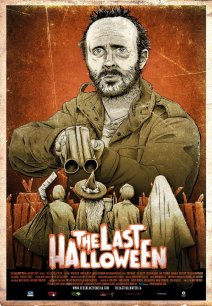
The Last HalloweenIt is still a bit early yet to think about but, believe it or not, Halloween is right around the corner. In the spirit of that horror-themed holiday which is so near and dear to our black hearts, I decided to review the 2013 short The Last Halloween.

The film was written and directed by Marc Roussel and tells the story of four kids trick ‘r treating in a post-apocalyptic town that has been decimated by an unknown epidemic. Despite the dismal setting the evening seems to be progressing well enough for them. That is, until they get to the last house where the owner, Jack, (Ron Basch) is less than welcoming.

For an indie short, the film certainly does have good production values and the decrepit town is well designed and detailed. The story is also interesting and Roussel does a good job building tension in a short amount of time. There are also nice touches throughout, such as Jack’s wife Kate (Emily Alatalo) looking forlornly at an empty crib which is genuinely sad moment that is subtly and effectively executed. In addition, I would be remiss if I didn’t properly acknowledge the excellent sound design which adds a level of professionalism to the production.

All that being said however, there were some significant issues to be found with the film as well. I don’t like to call out particular actors but I have to point out that while Basch’s performance was fine, it wasn’t quite to the level where he was fully selling the suspension of disbelief. During his screen time I felt quite aware that I was watching someone act and as a result wasn’t able to be fully immersed in the story.

The next issue involves the climax of the film and is simply too big to be ignored. I won’t give full on spoilers but if you are insistent on going into the film as fresh as possible I recommend taking the ten minutes now to pull the film up on YouTube before finishing the review.

Alright, all set now? So, suffice to say, the climax involves several monsters which, and there’s just no other way to say this, aren’t realistic enough to look scary. In fact, the scariest and tensest moment of the film was right before the monsters are revealed. After that, there is no denying you are looking at people in latex masks, quality ones certainly, but clearly masks nonetheless. In fact, at this point in the film the tone shifts to something more closely resembling a haunted house at an amusement park then a genuinely scary horror film.

Now, of course I understand the limitations of indie budgets but I feel that if the scene had simply been shot in a different way the end result could have been drastically different. For instance, obscuring the creatures in the shadows more and favoring quick edits rather than drawn-out closeups may have helped to create an atmosphere of genuine menace while also hiding the imperfections.

Overall though, a solid film that is definitely worth taking ten minutes to check out especially if you want to get into the spirit of All Hallows Eve as it draws ever closer.

2.5 Stars Red

Short Film Review: Familiar (2012) Duration: 24 min

FamiliarWith this review I conclude my current binge of Richard Powell shorts with his 2012 film Familiar, which was made between his shorts Worm and Heir. After seeing the caliber of his other films I was very intrigued to see how this one would stack up to the others and if he could in fact maintain the high level of quality I’ve come to expect from his films.

Naturally, the film stars Robert Nolan who also played the lead in both Worm and Heir. Similar to his character in Worm, Nolan plays John Dodd, a man who projects a facade of dutiful kindness but inside seethes with hate and disgust, this time for his wife and teenage daughter. As his hateful inner monologue becomes more angry and extreme, the question becomes “how far will he go to indulge the ugliness that lives inside him?”

It’s no surprise that Powell continues to use Robert Nolan as the lead for his films because he once again delivers a spot-on performance that subtly conveys the complex emotions of his character through his nuanced and skilled acting. It is not easy to play a character that is simultaneously hiding his true emotions from the other characters as well as subtly revealing them to the audience, but Nolan walks that line perfectly. Of course, supporting actors are also essential to the success of a film and Astrida Auza and Cat Hostick (John’s wife and daughter respectively) also deliver excellent, realistic performances that help immerse you in the world of the film.

In my review of Worm, I mentioned that although it was in fact a great film there were a few areas I felt could have been improved upon. Powell must have had similar thoughts when he made this because what he has delivered here is essentially a very similar story but with the supernatural elements as well as the brutal, gory climax that I felt Worm was lacking. This also allowed an opportunity for him to employ some gloriously grotesque special effects which look great even by Hollywood standards and are very impressive to see in a short film.

The storyline, which I always consider to be the most important part of any film, was also very well done here. I appreciate that it was well paced and showed what needed to be shown to move the story along without getting bogged down in unnecessary details or allowing the scenes to drag. The story is also genuinely unpredictable and set in a world where truly anything could happen.

Bottom line, another great one from Powell and company. I really hope he’s able to break into feature film territory soon because if he does, he could be the kind of unique and brilliant voice that is always needed out there in a world full of remakes and refuse. My one piece of advice for him would be to maintain his artistic integrity at all costs. The world doesn’t need any more directors of watered-down Hollywood sequels and if he can deliver the same kind of uncompromising brilliance in a feature film that we’ve seen in his shorts, then he just may carve out a place in film history as a significant filmmaker that is talked about for years to come.

4.5 Stars Red

Short Film Review: Worm (2010) Duration: 21 min 02 sec

WormFor this review I once again go into the dark mind of Richard Powell and dissect his 2010 short, Worm. After giving out one of my very rare five star ratings to his 2015 short Heir I was certainly interested to see how his other work compared. Does it stand on equal footing with the later film or is there a progression to the quality of his films that culminates in the outstanding 2015 film? Well, let’s discuss. By the way, some aspects of the ending are referenced here, not a full on reveal of course but all the same I feel a spoiler alert is warranted for this review just in case.

The plot of this film can be pretty simply summed up as a look inside the mind of an angry, burned-out high school teacher who has to put on a polite facade to interact with a world full of people he despises. This is definitely a concept that many of us can relate to, the difference between the fake, polite side we have to show the world and the true feelings that lurk underneath.

Frequent Powell collaborator Robert Nolan stars as said angry teacher and, as I expected, delivers another excellent performance full of subtly, realism and complex emotions that linger just beneath the surface. In fact, the entire cast, made up mostly of high school age teens, does a great job and portray their roles very effectively. I was pleased to see this because I feel like the competency of all actors in any given film, right down to the extras, is a detail that can make or break the overall quality of the film itself.

As far as the story is concerned, I do like the concept but found the overall film a bit anti-climatic. Now I’m sure this was a conscious choice by Powell to take the story in an even more unconventional direction but still, I was hoping there would be a supernatural element tied in or at least some gruesome violence.

I by no means think that gore and violence are a requirement for a film to be compelling or even disturbing, but in this case I feel that Worm needed a larger sense of purpose and a more significant event to occur in the protagonist’s life to bring the story to the next level. I would also mention that while the idea of a teacher losing his mind to progressively violent fantasies is in fact frightening conceptually, I would not actually classify this as a horror film, more of an unsettling drama.

Overall though, a very solid film that is well acted, well shot, and certainly compelling enough to easily hold your interest through the duration. Not quite Heir but still an interesting and engaging short that offers a glimpse of great things to come.

3.5 Stars Red

Short Film Review: Heir (2015) Duration: 13 mins 58 sec

HeirI see the format of short films in general as an opportunity for truly unbridled filmmaking. Even though the filmmakers themselves almost never see much in the way of financial gains from the actual shorts, they are also not beholden to the kinds of artistic compromises so often required to make a feature film marketable. This allows the most daring and talented directors to create short films that delve into dark subject matter and employ experimental techniques to create a vision untarnished by the meddling of outside forces who seek to make it more “palatable” for a wider audience. Directors who take advantage of that freedom are sometimes able to create films that are uninhibited, brilliant art pieces and Heir is one such film.

It is difficult to discuss the plot without giving too much away but I will say that it deals with subject matter that makes most people profoundly uncomfortable. The story centers around Gordon (Robert Nolan) who takes his teenage son Paul (Mateo D’Avino) on a trip to meet up with a mysterious man named Denis, played by Bill Oberst Jr. Tension and dread mount as the film builds towards it’s climax and the disturbing truth about the characters’ true motivations are revealed.

Writer/director Richard Powell takes a surreal approach to the story, clearly influenced by the kind of body-horror featured in Cronenberg’s most seminal work. This proves to be a smart gamble and the special effects are not only exquisitely crafted but give the film a nightmarish quality that will linger in your mind long after the credits roll. In the hands of a lesser director these effects may have undermined what is a very serious and upsetting topic but in this case Powell perfectly incorporates them into the story in a way that does justice to his influences. In fact, rarely outside of Cronenberg’s films have I seen body-horror so effectively used to symbolically portray the horror and darkness that can lurk in human sexuality.

Credit also must be given to the cast whose all around strong performances are a key part of the film’s success. Bill Oberst Jr especially shines with his subtle, menacing portrayal that is bold, daring and absolutely fucking flawless. Nolan also delivers in a big way expertly portraying his tortured character’s emotional roller coaster with subtly and realism. This is all captured in a tightly paced, professionally shot film that completely nails the tone, look and feel of the strange, disturbing story it is telling.

Even beyond the technical proficiency of the film the story itself is what really makes it daring and vital. Regardless of how well a film is shot there must be a deeper meaning to the story for it to cross the line from entertainment to significant art. By discussing a subject that is horrible but undeniably real, Powell elevates his film beyond the myriad of shorts that seek to merely shock and disgust to the all-too-infrequent group that truly have something to say. My hope is that this film becomes available in some way for people to watch outside of the festival circuit because it is without a doubt a trip into darkness well worth taking.

5 Stars Red