
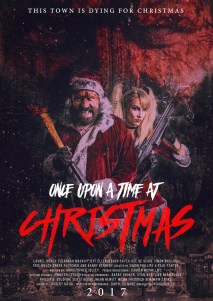
 When a horror movie has a holiday-themed premise, especially holidays other than Halloween, that’s often a sign that the audience is in for a campy ride that is going to play up the novelty to extreme proportions. Of course, that’s not always the case and some notable exceptions include the well-crafted, emotionally developed slasher Silent Night, Deadly Night as well as the incredibly creative and bizarre Rare Exports. Today, I discuss whether or not Once Upon a Time at Christmas falls into the category of holiday classics or if it’s just another poorly crafted product that falls apart almost immediately.
The story is set in the small town of Woodbridge New York where a maniacal couple in Santa suits (Simon Phillips) and (Sayla de Goede) begin a murderous rampage a few weeks before Christmas. Now it’s up to the local sheriff (Barry Kennedy) and a group of high school students to try and find out the reason for the killings and stop them before it’s too late.
When judging whether or not a film works, you really have to take into account what the director was going for in the first place. Clearly, in this instance, this is a film that’s intended as a fun holiday slasher, so judging it in terms of it’s realism isn’t a fair assessment. But even when viewed through that lens, there are some significant issues that prevent this from succeeding.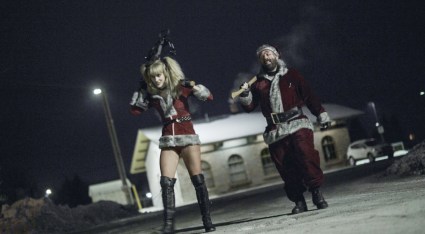
I don’t require a lot from a campy slasher to be entertained, but if you are going to ask me to sit through a silly premise with flat, generic characters that only exist to be slaughtered, then you at least need to bring the fucking blood. There are a lot of kills in OUaTaC, but for some baffling reason, director Paul Tanter takes a very timid approach to the violence. Even though numerous people are axe murdered, burned alive, or dispatched in other brutal ways, most of the violence occurs off camera or with very little blood. When the blood splatter does come, the film commits the egregious sin of using cheap CGI in place of a simple practical effect.
These kinds of half-measures are indicative of the film’s general approach to any remotely edgy content. This is perhaps best exemplified in the strip club scene that features zero nudity. Why even have it in there? I honestly don’t understand these half-hearted attempts at adult content that stop short of anything even slightly provocative. Why not just bleep out the fucking swears too, while you’re at it?
These issues of self-censorship wouldn’t be glaring if the overall film had a more solid foundation. Unfortunately, with so much cringe-worthy dialogue and uninspired characters, the film doesn’t really have a leg to stand on. Even for a slasher, the Claus’ near supernatural ability to appear wherever they need to is pushed to utterly absurd levels, and when the primary concept is finally revealed, it’s so goddamn silly that you’ll want to stab your eyes out with a candy cane.

It’s not all bad though, from a technical standpoint the film is well-crafted and some of the characters do put in solid performances, the sheriff and his deputy among them. The Claus’ also clearly get it and commit to their scenery chewing mayhem with the kind of unhinged enthusiasm that perfectly fits the tone of the film. And that’s the thing, there is fun to be had here and I wish there was a re-cut version that leaned into the gruesome madness instead of shying away from it. Had that version existed I would have wholeheartedly recommended it as a fun Xmas slasher, but as it is, this feels like the film equivalent of unwrapping a pair of socks on Christmas morning.

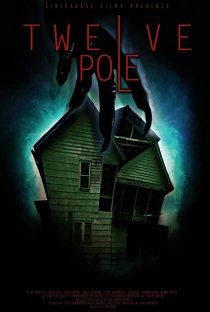 A good opening scene that grabs the viewers attention is very important for setting the tone of your film, especially in a horror movie. Conversely, when the opening of your film is so misguided that the audience is already rolling their eyes at minute one, you’re not off to a great start. Unfortunately, this is the case for Twelve Pole, which makes an incredibly lame attempt to be edgy by opening the film with a voice-over, warning the viewer about how graphic the movie is. Problem is, actual warnings like that aren’t a thing! Legitimately hardcore films don’t bother with such gimmicks, and for a film that doesn’t even qualify as Extreme Cinema, they’ve got some nerve pretending that a warning is required. Still, you can’t judge an entire film by a single misstep in the beginning, so let’s see how well the film itself holds up.
 Establishing the proper tone for a film can be very difficult to get just right, especially when your film incorporates elements of black comedy as well as horror. When it works it can be a very entertaining blend of genres that properly balances both, and when it doesn’t, it quickly devolves into a confused mess that serves neither. Today we’ll see if Murder Made Easy is able to strike the right balance with its modern take on an Agatha Christie style murder mystery.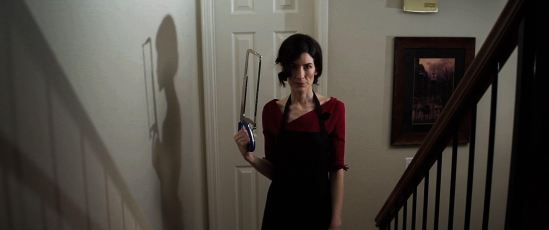
 While I can see why the overall plot itself was structured the way it was, the very device of having sequential guests show up does make much of the general plot rather predictable, and even a bit repetitive. Fortunately, as more of the larger story is revealed most of the characters have enough substance and variety to keep the interactions entertaining throughout…..with the notable exception of Cricket (Emilia Richeson). While most of the other characters are represented as slightly heightened archetypes, Cricket is full-blown New Age stereotype and her segment is the film’s most overt (and misguided) attempt at comedy, and a clear low point in the overall film itself. Had she simply been rewritten as a slightly more realistic character, her segment would have worked far better.
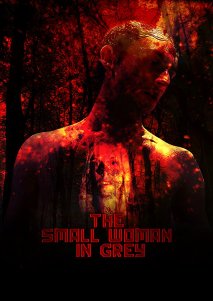 Ahhh the woods, the go to, ready-made set that is the favorite location for countless indie horror films. I understand the practicality of using this as a primary location, but aspiring filmmakers would do well to keep this advice in mind before they start lugging their cameras into the wilderness: If you are going to set your teen-massacring film in the woods, as we’ve seen countless times before, you’d better bring your fucking A game and show us a very creative and interesting twist on the most tired premise in horror. Otherwise, don’t bother showing up. So, even though it’s utilizing the most played out concept in horror cinema does The Small Woman in Grey elevate itself above the masses with a quality script and innovative filmmaking? Well, let’s discuss.
 When you think about the country of Turkey, ‘horror films’ probably isn’t the first thing that pops into your mind, but after the international success of Can Evrenol’s Baskin, that may be changing, at least a little. It certainly isn’t the first horror movie made in Turkey, but it is by far the most successful and just as A Serbian Film did in 2010, it puts an unexpected country into the international horror conversation. Based upon the 2013 short film of the same name, Baskin is a surreal and gruesome journey into a nightmarish world.
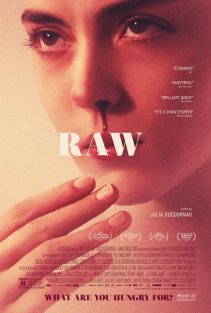 Sometimes the trailer for a film is so compelling and intriguing that you instantly know it’s a film you absolutely must see. For me, Raw was such a film and the dark, unusual, and clearly well-shot movie that was promised was one that I couldn’t wait to watch. Of course, a great trailer followed by months of waiting can certainly raise expectations for the film itself so the question is, did Raw live up to the hype and deliver on the high promise of the exquisitely made trailer? Well, lets discuss.
 No matter the size of your film’s budget there are always challenges to face. Big studio pictures have nearly unlimited resources but the filmmakers must contend with meddling producers dumbing down their vision until it’s palatable to a wide enough audience. Conversely, indie filmmakers have the freedom to explore innovative ideas regardless of their marketability but face the challenge of attaining the resources to properly execute their vision. Despite this disparity, both indie and Hollywood films are fighting for the exact same prize, the limited time and attention of a finite number of viewers.
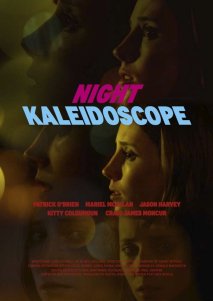 Some movies are created with an emphasis of style over substance, a deliberate attempt by the filmmaker to craft a compelling and surreal world that does not adhere to a standard narrative format. Suspiria, Lost Highway and Beyond the Black Rainbow are just a few examples of when this artistic gamble really pays off and pulls viewers into a compelling, living nightmare that brings you along for the ride, even if it’s not always clear where that ride is taking you. Conversely, when not done properly a lack of narrative only succeeds in creating frustration and quickly bores the viewer with a series of meaningless images. So, where does a film with a hallucinatory, dream-like style like Night Kaleidoscope fall on the spectrum? Well, let’s discuss.
  Psychological horror is often the best route to take for micro-budget films as it places more emphasis on creating an atmosphere of dread rather than elaborate set pieces. That being said, it can still be difficult to execute properly because without the gory spectacle to entertain viewers there is a greater importance placed upon the performances and the quality of the script to keep the audience engaged. The smaller the cast and fewer the locations the more important the acting and story become. So, does Flytrap, a film with one primary location and a very small cast have what it takes to provide an hour and a half of quality entertainment? Well, let’s discuss.
 Romeo’s Distress is a film that isn’t easy to classify as it does not fit neatly into a single genre. It’s not horror but more of a drama that’s heavily laden with dread and intrigue but also does get into more horrifying territory as it approaches the climax. As with any micro-budget film it’s success is going to be dependent on the level of innovation and creativity it brings to the table rather than high production values. So, is this film that was made for the shockingly low price tag of approximately $2,500 and shot well outside the studio system in New York state create an experience worthy of devoting eighty minutes of your time to? Well, let’s discuss.
 Horror and Alternative Cinema Reviews