Short Film Review: Heir (2015) Duration: 13 mins 58 sec

HeirI see the format of short films in general as an opportunity for truly unbridled filmmaking. Even though the filmmakers themselves almost never see much in the way of financial gains from the actual shorts, they are also not beholden to the kinds of artistic compromises so often required to make a feature film marketable. This allows the most daring and talented directors to create short films that delve into dark subject matter and employ experimental techniques to create a vision untarnished by the meddling of outside forces who seek to make it more “palatable” for a wider audience. Directors who take advantage of that freedom are sometimes able to create films that are uninhibited, brilliant art pieces and Heir is one such film.

It is difficult to discuss the plot without giving too much away but I will say that it deals with subject matter that makes most people profoundly uncomfortable. The story centers around Gordon (Robert Nolan) who takes his teenage son Paul (Mateo D’Avino) on a trip to meet up with a mysterious man named Denis, played by Bill Oberst Jr. Tension and dread mount as the film builds towards it’s climax and the disturbing truth about the characters’ true motivations are revealed.

Writer/director Richard Powell takes a surreal approach to the story, clearly influenced by the kind of body-horror featured in Cronenberg’s most seminal work. This proves to be a smart gamble and the special effects are not only exquisitely crafted but give the film a nightmarish quality that will linger in your mind long after the credits roll. In the hands of a lesser director these effects may have undermined what is a very serious and upsetting topic but in this case Powell perfectly incorporates them into the story in a way that does justice to his influences. In fact, rarely outside of Cronenberg’s films have I seen body-horror so effectively used to symbolically portray the horror and darkness that can lurk in human sexuality.

Credit also must be given to the cast whose all around strong performances are a key part of the film’s success. Bill Oberst Jr especially shines with his subtle, menacing portrayal that is bold, daring and absolutely fucking flawless. Nolan also delivers in a big way expertly portraying his tortured character’s emotional roller coaster with subtly and realism. This is all captured in a tightly paced, professionally shot film that completely nails the tone, look and feel of the strange, disturbing story it is telling.

Even beyond the technical proficiency of the film the story itself is what really makes it daring and vital. Regardless of how well a film is shot there must be a deeper meaning to the story for it to cross the line from entertainment to significant art. By discussing a subject that is horrible but undeniably real, Powell elevates his film beyond the myriad of shorts that seek to merely shock and disgust to the all-too-infrequent group that truly have something to say. My hope is that this film becomes available in some way for people to watch outside of the festival circuit because it is without a doubt a trip into darkness well worth taking.

5 Stars Red

Short Film Review: Stained (2016) Duration: 9 min 57 sec

Stained picWhen your film has a running time of under ten minutes there isn’t a lot of room to flesh out an elaborate story and the entirety of the film is generally focused on the resolution of one central conflict. Stained is no exception to this rule, and the plot can easily be summed up as (sigh)…..a man takes a shit and has to try and find some toilet paper to wipe his ass. Yes, that’s really the plot.

Said man goes by Harris (Mike Shephard) and in addition to being fresh out of TP, he is also plagued by the the incessant harassment of one Fecal George (Chris Spyrides), a human manifestation of shit itself that only he can see. Okay, so it goes without saying that the plot is crass and sophomoric, so the question really becomes “did the filmmakers execute the story they had properly?” Well, let’s break this thing down.

First and foremost, this is a small cast of three actors so the quality of the acting is essential to selling this weird little story. Not surprisingly, there isn’t much subtly to be had in their performances which consist of the kind of broad, cheesy acting you’d find on your typical short-lived sitcom. I recognize that an over-the-top style was warranted in this outlandish story but I still feel that more skilled actors could have delivered a level of subtle menace that would have added complexity to the characters. Though, I can certainly appreciate that having anthropomorphized human excrement shouting at you about shit stains in your underwear probably doesn’t inspire your best performance.

What baffles me the most about this film is why director Phil Haine and writer Mark A. C. Brown felt that, of all the possible stories in the world, this was the one that they would put all their resources into telling. Now, if this had come off as a film that looked like it was shot over a weekend by a couple of drunken college kids, it would actually make more sense. What’s confounding here is the fact that there’s clearly a lot of talent behind the camera.

There are some attempts at very broad comedy that fall completely flat but purely from a technical standpoint the film is very well crafted. The quality of the image is perfect, the sound design is excellent, and the entire experience flows together with the kind of professionalism you’d expect from a multi-million dollar film.

Now, I won’t spoil the ending, but I will say that it does redeem the rest of the plot a bit as well as provide justification to some points of the film that seemed like simple oversights at first. In addition, it finally tied in the Horror aspect that had seemed to be conspicuously absent from this “Horror Comedy”. All in all, a strange, gross little story but one brought forth by talented people who are certainly worth keeping an eye on in the future.

2.5 Stars Red

The Hills Have Eyes Part 2 (1984) vs The Hills Have Eyes 2 (2007)

The Hills Have Eyes 2

For this review I go back into the desert to compare the 1984 sequel for The Hills Have Eyes to the modern remake of the same name. Unlike the original and it’s remake however, the storylines in the sequels are vastly different from each other but do both tie back in to the originals that they follow. Was it worth taking the trip into the bloody, radioactive sand again or should the sequels be avoided like a sketchy, unmarked dirt-road in the desert? Well, let’s discuss.

The 1984 version, The Hills Have Eyes Part 2, starts with one of the survivors from the original, Bobby (Robert Houston), talking to a psychiatrist about his experience. When a group of his friends want him to join them at a race in the desert so they can pass out samples of a new dirt-bike fuel he invented (!) he declines and warns them not to go either. Of course they go anyway bringing along his dog Beast and the now civilized Ruby, who is also part of the crew but lives under a new identity. After an ill-advised shortcut and a predictable break-down, the gang finds themselves on the receiving end of the same kind of desert hospitality that Bobby and his family got in the first film.

By contrast, the 2007 version, The Hills Have Eyes 2, takes place after the events of the 2006 Hills film but does not connect directly to it with any of the characters. Instead, it centers around a group of young National Guard recruits that are halfway through training. On their way to another training location, they are tasked with dropping off equipment to a group of military scientists that are working on a mysterious project in the desert. Once there, they find the camp is deserted……or so they thought!

Ok, so as you can imagine, neither one of these sequels has been particularly well received by critics or fans. This isn’t especially surprising considering that both the original 1977 film as well as it’s 2006 remake were such good films that they made for tough acts to follow. Additionally, neither sequel exactly brought it’s A-game and both cases feel like a cash-in rather than a thought out expansion on the story. Even so, there were still some striking differences between the two versions.

Perhaps the most glaring of these is the fact that the 1984 version shamelessly recycles footage from the first film. It does so under the guise of “flashbacks” but what you really have is a highlight reel of scenes from the first film that simply play again, in their entirety, in the sequel. Honestly, I can’t think of any other sequel that so blatantly uses a device as cheap as cut ‘n paste to this extent simply to make their lackluster film more interesting.

If this was the only issue with this version it may have been forgivable (maybe) but the fact is this one is rancid all the way through. Right from the group of annoying twenty-something protagonists who you instantly want to die, to the repetitive fake-out scares, to the shoddy (and sparse) gore, there really is nothing to recommend about this film. It utilizes the most cliched and over-used plot in the Horror genre (group of young people in middle of nowhere picked off by villain) and even when Craven wasn’t recycling actual footage from the first film, he still recycled ideas for plot points and kills. Even the character of The Reaper (one of only two hill-people in this one) makes no sense because if you paid attention to the plot in the first film you’ realize there’s no fucking way that Jupiter could have possibly had a brother that was simply absent during that film.

The most baffling part of this is the fact that these are the kinds of things you would expect to find in a sequel that’s made by a different director and rushed out the next year but in this case the sequel was written and directed by Wes Craven himself seven fucking years later! In other words, plenty of time for the original creator to craft a brilliant follow-up to his own film.

The 2007 version on the other hand was made by a different director and rushed out the next year but against all logic it’s actually, well, good. Now, to be fair it’s nothing earth-shattering and the 2006 version definitely leaves it in the dust but in this case director Martin Weisz does deliver a solid, gory film that is very watchable and will keep your attention to the end. This may have to do with the fact that the 2007 sequel was written by….wait for it….Wes Craven!

That’s right, after wisely stepping into the Producer’s chair for the 2006 remake so writer/director Alexandre Aja could flex his creative muscle, Craven got back into the game for the 2007 sequel and wrote the screenplay with his son, Jonathan Craven. I feel like this must have at least partially motivated by a desire to make amends for the immensely disappointing 1984 sequel and show that he could deliver fans a proper, if long overdue, sequel to one of his most iconic films. After taking the bloody, entertaining ride myself I can certainly say I’m glad he did.

Winner The Hills Have Eyes 2007

The Human Centipede 3: Final Sequence (2015)

The_Human_Centipede_3_PosterWhen you’ve already created one of the most original and disturbing horror movies of all time and a sequel that takes it to the next level, the natural question must be “where do you go from there?” With The Human Centipede 3: Final Sequence writer/director Tom Six closes out his infamous horror trilogy with one final entry, a last trip into the sick, twisted world he created. So, does the final entry live up to high expectations set by the first two? Well, let’s discuss…

Using the same plot device that he did in the second film Six posits that this film is in fact the true reality and the other two are fictional movies in this world. Dieter Laser returns as prison warden Bill Boss and Laurence Harvey comes back as his accountant, Dwight Butler. When other forms of draconian punishment prove ineffective they decide to take inspiration from the notorious films and put the entire prison population into a massive, 500 person centipede.

The most noticeable change in this film is the drastic tonal shift from the last two, especially the second entry. Now, it should be noted that Six has always maintained that he sees the films as dark comedies, which is a strange claim indeed. At least that’s what I thought when I saw the first two, which are some of the most grim, brutal and disturbing cinematic trips you will ever take. The third however, is played for laughs…..

The general rule of thumb with movie sequels and TV shows is that once they start making fun of themselves they’ve run out of ideas and this film drives that point home, drives it home hard. Right from the onset where the central idea is recycled, to the constant self-referential nature of the film and the fact that Tom Six makes an awkward appearance as himself, the running theme is clearly ‘no one in this movie is taking this shit seriously’. And truly, they are not.

Laser is without a doubt the worst offender in this regard as he ditches the subtle, genuine menace of Dr. Heiter in favor of prancing around like a maniac and screaming all his lines. In addition, Bill Boss is less like a prison warden, more like Caligula as he snacks on dried clitorises, rapes his secretary and castrates, mutilates and murders prisoners with absolutely no legal repercussions. Basically, the film is played as a broad comedy punctuated by scenes of graphic violence. This idea may have been more effective if the film had at least been remotely funny.

This brings me to the fundamental problem with the movie. If you are going to jettison your previous format, you need to bring in something solid to replace it with. Since the world and the characters of this film aren’t grounded in any kind of tangible reality the situations they are in become far less engaging as you can’t take anything seriously. This results in irritation for the viewer as they simply wait for the next violent scene to alleviate the boredom that occurs when there is no solid plot to follow or well-developed characters to engage with.

In conclusion, it’s unfortunate that Tom Six didn’t try to push himself creatively to finish the trilogy strong and instead elected to smugly rest on his laurels and assume we would all be impressed merely by the fact that he fucking showed up. Even the violence, while graphic and generally creative, doesn’t really feel boundary-pushing or dangerous as it did in the second entry and wasn’t pushed nearly as far as it should have been. Overall, a tremendous opportunity wasted and while I found the film enjoyable enough to watch once, that doesn’t change the fact that the series would have been so much better off had this one never been made.

2 Stars Red

Uncle Sam (1996)

220px-UncleSamSlasherAs any horror fan knows, there is no shortage of holiday-themed horror films out there. However, while holidays like Halloween and Christmas boast a multitude of titles, less represented holidays like say, 4th of July have far fewer movies modeled after them. That being said, it’s hard to imagine a movie ever being made that could more enthusiastically embrace the patriotic American holiday than Uncle Sam.
The plot centers around Master Sergeant Sam Harper (David ‘Shark’ Fralick), a helicopter gunner who is killed by friendly fire during the Gulf War. When his body is shipped back to the states for burial his young nephew Jody (Christopher Ogden) becomes obsessed with him and following in his footsteps. But it isn’t long before Harper’s restless corpse awakens, steals an Uncle Sam outfit and goes on a bloody rampage against draft-dodgers, flag burners, corrupt politicians and anyone else who dares defile the honor of his beloved country. Will Jody have the courage to defend the town and stand up to his….(sigh) uncle, Sam?

While the idea of a murderous reanimated corpse in an Uncle Sam costume is indeed strange, what’s even more bizarre is that this weird throw-away film from the 90’s wasn’t directed by a first timer nobody, it was directed by fucking William Lustig! In fact, despite consistently working as a producer up till present day, Uncle Sam actually represents the final feature film the director of the seminal slasher Maniac has directed to date.

When you go into a movie like Uncle Sam you have a good idea what to expect. Clearly you’re not going to get brilliance but if the film can keep you entertained with a cheesy story and plenty of gruesome kills then it’s done it’s job. Unfortunately, this is where the film ultimately fails as it commits the only truly unforgivable sin of the cheesy slasher sub-genre…..it bores the audience. Aside from the opening scene there aren’t any kills until forty-two minutes in!

Evidently, a lot of padding was needed to stretch out the paper-thin story and even though the second half does pick up a bit, it’s too little too late. Some of the kills are creative and decently bloody but without the kind of glorious, gooey over-the-top madness we saw in 80’s films or the sleek, realistic gore of modern day horror this is a classic example of why the 90’s were considered an overall low point in the history of the Horror genre.

There are some things I did appreciate about this film, though. Primarily how it so fully embraced the underrepresented holiday with such gleeful abandon making this a film that doesn’t just take place on the 4th of July but is, without a doubt, a 4th of July themed horror movie, and all holidays should have at least one horror film that fully represents them. I also have to give props to the credit sequence which not only establishes the iconic Uncle Sam outfit for the viewer through real archival footage but also shows how genuinely bizarre and creepy it could be at times.

If this doesn’t sound like enough to recommend the film, it’s because it’s not. The movie is not even remotely scary which is largely due to the fact that the titular villain spends most of the time standing in plain view so there is never even a chance of tension or dread building before a kill. Even with the cheesy concept and low budget this film could have succeeded if it had jumped right into the action and assaulted the viewer with a series of brutal kills that didn’t let up. At least then it would have made for a fun movie to watch with a few friends and more than a few drinks. As it is, watching this is about as exciting as celebrating the holiday with a damp sparkler and a non-alcoholic beer.

1 Star Red

Short Film Review: Feed the Black (2016) Duration: 32 min

Feed the BlackAs you can imagine, I’ve seen a lot of films in my day and always enjoy seeking out the most bizarre, abstract and downright weird films I can find. I can safely say however that I have never seen a film, especially a short, that starts with a guided meditation (!). But that’s exactly what happens at the beginning of Feed the Black, the viewer is instructed to close their eyes and empty their mind while a voice-over prattles on for almost five full minutes! That’s a significant chunk of time when the total running time is only about thirty-two minutes. If the V.O. contained important plot information or tied back into the film at a later point this could perhaps have been justified but as it is it feels incredibly extraneous.
After this, the film finally starts. The plot, such as it is, follows a nameless woman who visits a grave and shoots heroin for the next ten minutes of screen time while classical music plays. This is interrupted only by the occasional scene featuring quickly flashing images of religious iconography, a giant eyeball and other typical abstract film cliches. We are now halfway through. The remainder of the film continues along the same lines: she wakes up mysteriously in a forest, she walks through an old colonial town, a cemetery, there’s a human sacrifice, et cetera, et cetera. Throw in some mysterious shrouded figures, a few more seizure-inducing montages, trippy kaleidoscope editing effects, end on the titular line and….voila!

Truly, I haven’t seen something quite like this since my days in film school. In fact writer/director Klayton Dean falls into many of the same traps that film students do when trying too hard to create a significant, abstract work. First and foremost it’s pretentious as fuck. The Roman numerals dividing the sections, the classical music, the old English script for the end credits, it all tries desperately to impose a greater significance onto the footage that simply isn’t there. What’s missing is a cohesive story and a connection to the protagonist that is strong enough to make you want to take a bizarre journey with her.

A common misconception about abstract films is that they are supposed to be comprised of a nearly unintelligible collection of images that will take on greater significance simply by being confounding and bizarre. The reality, however, is that the director must lay a path for savvy viewers to follow so that the intended message of the film can be interpreted, otherwise it’s just weird for the sake of weird and has little value. This is a concept that surreal masters like Lynch and Jodorowsky understand as they layer their bizarre imagery with hidden meaning and complex social commentary. With symbolic imagery, there should be specific meaning tied to each image, most of which is also propelling the central story forward, not simply presenting vague ideas and general concepts like “the struggle between dark and light”.

Despite the shortcomings of this film I do feel that Klayton Dean has potential as a director. The film is well shot, the quality of the image is solid and the acting works. Unfortunately, without a solid foundation these qualities become irrelevant and Dean will need to get out of his own way before he can create something of real significance. However, with a solid, cohesive script in his hand he could be a force to be reckoned with.

In closing I also want to mention that it is a stretch to even classify this as a horror film. Honestly, the only thing shocking about this is that Dean sees fit to charge viewers to watch it. Even if it was much, much better than it is, it still wouldn’t be worth paying four bucks to own a thirty minute movie. This is the kind of film that should be free on YouTube, after it’s cut down to a third of it’s current length.

1 Star Red


Father’s Day (2011)

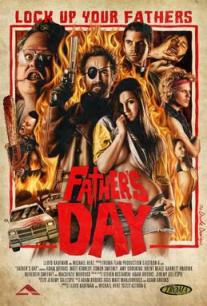
Father's_Day_PosterCorpse mutilation! Necrophilia! Cannibalism! And that’s just the first two minutes! Welcome to Father’s Day, motherfuckers! The 2011 film is the twisted brainchild of the five-man Canadian writing/directing team collectively known as Astron-6.

The central plot focuses on an unlikely trio comprised of a vigilante, a priest, and a gay prostitute as they try to track down and kill the murderous father-raping demon known as The Fuchman AKA The Father’s Day Killer. With an insanely low budget of $10,000 the Troma-produced film features enough gut-churning gore to put most of the Saw franchise to shame. So was the end result a worthwhile effort that can stand up against the sea of multi-million dollar horror flicks out there or was it just another overly ambitious indie film that falls short? Well, let’s discuss.

The first thing I want to mention is that you must go into this with the understanding that this is a stylized film and is meant to be viewed as such. The entire movie is an homage to the kind of over-the-top 80’s horror that you’d find a random VHS of on your local video store shelves, back when that was a thing. The look of the film is deliberately degraded, and the entire movie is presented with tongue-in-cheek, overly dramatic plot and dialogue that lovingly mimics the plethora of cheap films that do similar stories in earnest.

It is very difficult to create a film, especially with very limited resources, that successfully emulates and parodies bad films without actually becoming one itself. However, much like Robert Rodriguez’s Planet Terror, this film was created by filmmakers with enough talent and knowledge of the source material to pull off a movie that really works. This is in large part due to the fact that the film is primarily a self-aware black comedy that incorporates elements of horror and scenes of graphic violence into the plot. What’s more is that the comedic elements of the film actually work and the story is compelling and interesting enough that you want to strap in for the crazy ride and see where it takes you.

The real star of the show here however is the gore, which is cranked up to astoundingly graphic levels. Eyeballs are sliced, heads are smashed in, dicks are bitten off and so much more in horrifying, unflinching detail. If that wasn’t enough for you the film also throws in copious amounts of boobs and taboo-smashing scenes of underage prostitution, incest and many shots of men being graphically raped. Yet all this is done in the context of a story that maintains a fun, goofy feeling and is not meant to be taken too seriously. Add to this some amazing stunt work, like jumping between real moving trucks and actors being set on fire (!), and some incredible otherworldly character and set design and you have a truly impressive indie film. It may not be breaking any new ground in terms of story and film technique but what it does, it does very well.

In conclusion, this is the kind of movie I’m always hoping indie films will be when I put them on. Something that shows a lot of passion and talent from the filmmakers involved and is able to push the boundaries way past what could be made within the Hollywood system. So crack open a cold beer, or six, and enjoy the gleeful insanity of what may be the greatest film Troma ever produces.

4 Stars Red

The Human Centipede 2: Full Sequence (2011)

TheHumanCentipede2How do you follow-up one of the most shocking and original horror movies of all time? Is it even possible to make a movie that’s more disturbing than The Human Centipede? Well, I’ll save you the suspense….yes, it most certainly fucking is! Once again I enter the astoundingly twisted world of writer/director Tom Six to see how The Human Centipede 2: Full Sequence stacks up against the ground-breaking original.

In the world of this film the first Human Centipede is just a fictional movie, one that Martin (Laurence R. Harvey), the mentally challenged parking attendant in a London garage happens to be obsessed with. When he isn’t busy jacking off with sandpaper while he watches it or feeding his pet centipede he likes to spend his time brutalizing garage patrons with a crowbar and putting them in the back of his van. Once collected, the unfortunate (that’s an understatement to say the least) victims are brought to his secluded warehouse so he can live out his greatest fantasy, creating a human centipede of his very own.

Before I get into this I just want to mention that I am always a big supporter of watching the completely uncut versions of films. Unfortunately, Netflix really decided to fuck over streaming viewers and only provides a censored cut. Don’t get me wrong, it’s still horrific but some key scenes were removed without any indication to the viewer that this is not the full version. Apparently, the Blu-ray features the fully uncut version so if you are inclined to watch it, I recommend getting that.

Alright, so the first film got a lot of mileage simply from the fact that it was a truly original concept with a plot so horrifying that many people cringed at the very mention of the title. Since the concept is no longer original the only logical thing Tom Six could do is go bigger and badder with the central idea, which is exactly what he does. All the dark, disturbing imagery from the first is brought back and cranked up to 11. The sheer level of graphic brutality on display is astonishing and this is without a doubt one of the most shocking and disturbing films ever made, making the original pale by comparison.

Beyond the gore though, there are also some very bold and interesting choices with how the film itself is constructed. The most notable of these is naturally the choice to make the film black and white. There has been a lot of online speculation that Six was forced to present it in this way due to it’s graphic content but in a 2011 interview with wegotthiscovered.com he clearly states that this was an artistic choice to make the film feel darker and more uncomfortable. The gamble pays off and the film not only takes on an even more grim, desolate tone but also differentiates itself from the style and feel of the original.

I also thought it was a bold and interesting choice to make the protagonist a fan of the original film who is inspired to do violent, horrible acts that emulate what he sees in it. With this, Six is really taking the unfounded argument made by so many people that violence in art causes real-world violence head-on rather than side-stepping or apologizing for it. Bolder still, he makes the villain the protagonist of the film this time, a reversal from the original, putting us squarely in the front seat of this twisted ride, unable to deny our own voyeuristic part in the acts we are witnessing.

This also plays into the wish fulfillment aspect of the film as Martin, who is both physically and mentally weak, is able to violently dominate anyone he chooses. I’m sure it’s also no coincidence that most, if not all, of the people he assaults have been rude, mean or violent towards him in some way. It’s artistic choices like this that make the viewer confront their own sick, violent nature which is perhaps the most unsettling part of all.

In conclusion, this is not a film to be underestimated or dismissed as mindless shock value. I can’t say the story is particularly complex or deep but the film takes the series exactly where it needed to go and creates a glorious, uncompromising vision and reminds us that horror is supposed to be horrifying.

4 Stars Red

The Hills Have Eyes (1977) vs The Hills Have Eyes (2006)

The Hills Have Eyes

Doing a comparison of The Hills Have Eyes original vs remake was challenging in the same way that the Black Christmas comparison was, although for the opposite reason. In this case both films were so well done that an obvious winner wasn’t instantly apparent as it is in some cases (ahem Dark Water).

Both films follow the same basic storyline pretty closely (not a given for all remakes) which involves a family crossing the desert on their way to California. Soon after stopping at a remote gas station, they crash their vehicle and become stranded. It’s not long before a family of cannibals descends upon them and shit gets real.

The main thing that makes both the original and the remake so effective, is that the characters are realistic and well-defined. I’m glad that the filmmakers in both cases understood that you don’t need long drawn-out scenes of exposition and character-development to make the viewer attached to the protagonists. Both directors wisely opt to efficiently establish everything you need to know about the characters with minimal, but telling, interactions. In both films you really feel for these people who are trapped in a horrible situation and feel that they are doing the best they can to figure a way out of it.

Both films are also brutal, mean-spirited stories without any levity once the action gets under way, which is what I love about them. It’s great to see serious, visceral horror with characters you actually care about. Movies like this also aren’t shy about killing them off so the stakes are actually high because any of them could die at any time. I find this to be a much more satisfying experience than waiting for a cast of cheap stereotypes to get butchered.

While the story and characters of the original are great, there are certainly some areas that could have been tightened up a bit. First on my list would be the outfits worn by the cannibal family, some of which have a bit of a “Flintstones-Halloween-costume” vibe to them. In addition to munching on human flesh, said family also had a bit of a habit of chewing the scenery and some of the performances would have been more effectively menacing had they been tempered a bit. Another issue is the gore which, while certainly good for the era, at times looks a bit dated and fake by today’s standards.

To be fair, the remake has the advantage not only of modern special effects, which look fucking great by the way, but also a solid story that is already laid out for filmmakers. Still, there were some interesting alterations that director Alexandre Aja made to Wes Craven’s original film. Perhaps the most noticeable of these is that the cannibals are significantly more deformed in the remake which is a result of nuclear radiation from tests performed in the area over the years. This makes them more monstrous than the cannibals in the original whose minor abnormalities stem back to a patriarch born with a mysterious genetic condition. Right from the brilliant opening title sequence that features chilling footage of real nuclear bomb detonation, Aja establishes nuclear proliferation as an underlying theme throughout the film and in effect the true genesis of the monsters themselves. To this point the monsters could in fact be perceived as representing the merciless destruction caused by nuclear weapons when used against average civilians.

In conclusion, the 2006 version is a rare example of exactly what a remake should be. You take a film from decades before that has a solid, worthwhile story and update it with sleeker production values and more visceral gore for today’s desensitized audiences. The most important thing however, is to keep the elements that made the original film work in the first place, which Aja has done while infusing it with his own style of gorgeous brutality. If more remakes followed his example the concept of remakes in general wouldn’t carry the well-earned stigma of simply being a way for Hollywood to make a quick buck with minimum effort.

Winner The Hills Have Eyes 2006

Michael Myers: Absolute Evil (2016)

Michael Myers Absolute Evil -bannerThe plot of Michael Myers: Absolute Evil can simply be summed as a mockumentary which discusses Michael Myers as though he were a real serial killer. However, unlike most mockumentaries this is not a comedy and is presented in the same kind of tone that you would find with a typical documentary about a real serial killer. This is certainly an interesting, unusual approach so the question becomes, does it pay off?

I do like the idea here but I think the very concept runs into a fundamental problem. The reason documentaries are engaging is because you’re learning details about a real person or event and the experience can be a fascinating journey of discovery. We accept that documentaries are mainly made up of talking heads, still photos and low production value reenactments because the information we are learning is compelling and real. On the other hand, mockumentaries are traditionally presented as dead-pan comedies that revolve around a completely fictional subject, think This is Spinal Tap, where the enjoyment is derived simply from the fact that the film is funny.

Since this film doesn’t meet either criteria I would have to assume that writer/director Rick Gawel created this to be viewed as a realistic documentary that just happens to be about a fictional subject. In this regard there are a few parts that could be tightened up to sell the idea that this is a real documentary. One example is a scene which contains an archival interview that we’re told takes place in 1964 but is clearly shot digitally with an after-effect put on during editing, which is noticeable. If the footage had actually been shot on film for that scene it could have come across as authentic. I had a similar problem with the title cards between interviews which are given a deliberate effect to make them appear old and flicker in and out of focus. The effect looks fine but creates a disconnect between the cards and the crisp, digital interview footage.

There were also some scenes shot specifically for this film that are created to expand upon the mythos but these largely fall flat. The cult leader especially didn’t read as charismatic or menacing enough to be believable and the awkwardly long short film that’s spliced in near the end never elevates itself beyond the typical found-footage films that have long since worn out their welcome.

This is a shame because the actual documentary parts of this film are quite well done and do for the most part feel like an authentic documentary. Gawel’s use of black and white stills is done masterfully as he takes the viewer through the history of Michael Myers as though it was one cohesive story, which is no easy feat considering how disjointed the films themselves could be at times. The interview subjects are for the most part quite believable and effective, although there are some notable exceptions including one man that appeared to be looking down at an off-screen script in-between lines (!).

Ultimately, it’s a very interesting idea that would be great as a short 20-30 minute film but begins to become tedious when stretched out to an hour and a half. It’s cool to see the overarching story presented in this way but there isn’t really much in the way of new insights or information to be gained by watching this that you couldn’t get from simply seeing the films. This is a clever concept with some nice touches, I like the subtle diss of the remake that was slipped in, but one that ends up being more of a novelty for fans rather than essential viewing.

2.5 Stars Red