Raw (2017)

RawSometimes the trailer for a film is so compelling and intriguing that you instantly know it’s a film you absolutely must see. For me, Raw was such a film and the dark, unusual, and clearly well-shot movie that was promised was one that I couldn’t wait to watch. Of course, a great trailer followed by months of waiting can certainly raise expectations for the film itself so the question is, did Raw live up to the hype and deliver on the high promise of the exquisitely made trailer? Well, lets discuss.
The story follows Justine (Garance Marillier), a young woman from a strict vegetarian family, who is going off to the veterinary school that her rebellious sister Alexia (Ella Rumpf ) already attends. After being forced into eating meat in an initiation ritual, Justine soon begins to have an insatiable craving for flesh that she struggles to control. That’s about all I want to reveal about the story because, truly one of the best things about it, is the shocking twists and unpredictable plot.

What’s instantly apparent when watching this film is just how incredibly well made it is. The cast, primarily consisting of young adult actors, is absolutely flawless and their strong, realistic performances are a huge part of what makes it successful. The lion’s share of the credit, however, belongs to writer/director Julia Ducournau, who’s brilliant script and assured direction, are responsible for creating a film that is visually stunning and thoroughly compelling.

It’s utterly amazing that this is Ducournau’s debut feature because, the way she skillfully balances the elements of a coming-of-age drama that’s infused with horror, is nothing short of masterful. The story is not only very different from what I assumed it would be going in, but also remained unpredictable throughout and was certainly a far cry from what Hollywood would have done with the material. The twists in the story make for some surprisingly shocking moments and the subtext about discovering one’s sexuality (and the horrors that go with it) is expertly infused into the story.

The fact that Ducournau relied on real animals and practical effects over CGI adds to the overall realism and, while this is not an extremely bloody film overall, the gore effects that are present are pulled off perfectly. All in all, this is a film that actually does live up to the promise of it’s trailer and, although it’s not exactly a horror film, it’s a horrific and beautiful journey that is very much worth taking.

4-5-stars-red

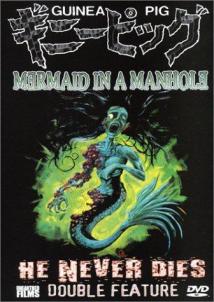
Guinea Pig 6: Mermaid in a Manhole (1988)

GP6With this review I wrap up the original Guinea Pig series with the final (produced) entry, Mermaid in a Manhole. With the notable exception of the “comedic” outlier, Devil Doctor Woman, the series so far has ranged from solid to very good and set a high standard for Extreme Cinema that is rarely equaled to this day. So, does the final film live up to the expectations set by it’s predecessors or does the series fall flat at the finish line? Well, let’s discuss.
Unlike many of the entries, this film has a very clear narrative structure and is actually the only one in the series to not use any kind of framing device for the main story. The story itself centers around an artist (Shigeru Saiki) who copes with the grief of his wife leaving him by going into the sewer and painting the filthy and decrepit things he sees. On one such trip he discovers a mermaid (Mari Somei) who has become trapped down there and brings her home to try and heal the festering sores on her stomach. Her condition rapidly grows worse however and as she becomes more and more disfigured by her ailment she begs the artist to paint her before she dies.

This film marks the return of Flower of Flesh and Blood director, Hideshi Hino, and it’s no coincidence that these two entries are not only the most brutal of the series, but also generally the most well regarded among fans. As good as FoFaB was though, it is refreshing to see Hino take a very different approach with this one rather than rehashing the same premise. Mermaid not only presents a very creative concept but also features surprisingly well developed characters and a genuinely tragic story, complete with an ambiguous twist ending that will make you question everything you saw leading up to it. Since the film is based upon a Manga that Hino himself created, it’s no surprise that the story is well fleshed out and uncompromising.

This film also takes a very interesting and unusual approach to body horror because rather than showing a man torturing a woman, it shows him spending most of the time trying to help her, but with no less grotesque results. In fact, I think a strong case could be made for this being the most gruesome, disturbing and difficult to watch of the entire series. There’s something about seeing someone writhe in agony as grotesque tumors riddle their body that is so much more disturbing than seeing them being tortured by a person. Of course, that’s just where the film starts and before long the artist is painting with her multi-colored pus, pulling live worms from her tumors and cleaning up piles of them from her bloody puke. It’s okay, you can go throw up, I’ll wait.

All these scenes are pulled off with the well-crafted, gruesome practical effects we’ve come to expect from the series, complete with copious amounts of actual, slimy, wriggling worms and bugs. As far as I’m concerned extreme films like this function as a kind of litmus test for those who claim to be fans of movies that are meant to horrify. In a world filled with art that is compromised and censored in the interest of “morality” and mass appeal, it’s always great to see the vision of an artist who doesn’t give the slightest fuck about how the audience will react to their work. Plus, it’s by far the most fucked up movie involving a mermaid that has ever been, or will be, created.

4-stars-red

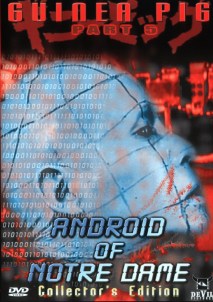
Guinea Pig 5: Android of Notre Dame (1988)

GP5After achieving new heights of gloriously sadistic violence with the second installment, Flower of Flesh and Blood, the Guinea Pig series took a hard turn into comedy territory in the third (and especially) fourth entries, much to the detriment of the franchise. However, the fifth entry, Android of Notre Dame, drastically shifts the tone once again back to somber and serious. While this is certainly a welcome realignment of the series, the important question of how well the film itself works is still the primary factor. Now, a quick aside, I am, of course, aware that the fourth entry, Devil Doctor Woman was actually released after the other five but, since this is a retroactive review of the series, I am doing the films in the order they were produced rather than released.

Counter to early entries that were very light on actual plot, this installment represents the first time in the series that an attempt is made to incorporate a storyline that’s really grounded in a dramatic, character-driven plot. Said plot centers around Dr. Karazawa, a diminutive scientist who performs highly unethical human experiments in his basement lab, desperately trying to find a cure for his dying sister. Seemingly out a nowhere, a mysterious man named Kato, who knows all the details of the doctor’s experiments, calls him up and offers a business deal to help with the research. Karazawa begrudgingly accepts but it isn’t long before Kato shows up in person and reveals his true motivation for contacting the doctor.

Overall, the story works quite well and provides seriously portrayed characters with complex motivations that aren’t simply playing for gross-out laughs as in the previous two films. Still, viewers expecting the faux-snuff experience of the first two entries that gets right to the point with the brutality may be dissapointed with the occasional slow pace of this film.

This is a story worth sticking with though, because it’s not long before the plot veers into the kind of glorious insanity that makes extreme Japanese cinema so much fun in the first place. By incorporating sci-fi elements like a living severed head, robotic arms, and corpse resurrection, Android takes the series in a wonderfully weird direction. My only real complaint here is the wraparound plot with Karazawa as an old man that doesn’t tie very well to the actual story and could have simply been cut without being missed.

Since this is a Guinea Pig film, fans come in expecting a certain level of graphic violence and on that, Android delivers quite nicely. That being said, there are times when the illusion is betrayed by some inexplicably cheap looking effects, but there are enough well-executed, extremely gruesome shots to make up for it. Eyeballs are pulled out with the optic nerve still attached, ribs are broken off one by one, and organs graphically ripped out just to name a few.

Overall this film has some imperfections but in the end, gets the series back on track by delivering the dark tone and obscenely graphic violence that we expect from a proper Guinea Pig film.

3-5-stars-red

Kudzu Zombies (2017)

KudzuNo matter the size of your film’s budget there are always challenges to face. Big studio pictures have nearly unlimited resources but the filmmakers must contend with meddling producers dumbing down their vision until it’s palatable to a wide enough audience. Conversely, indie filmmakers have the freedom to explore innovative ideas regardless of their marketability but face the challenge of attaining the resources to properly execute their vision. Despite this disparity, both indie and Hollywood films are fighting for the exact same prize, the limited time and attention of a finite number of viewers.

Considering the fact that there is no shortage of entertainment to spend our free time indulging in, why would anyone choose to watch films with inexperienced actors and homemade special effects over slick, high budget entertainment? Well, the reason you chose to overlook the rougher, DIY aspects of indie films is because they are the ones that push the creative boundaries and try daring new things that the high-budget films don’t have the balls to attempt. However, when an indie film simply tries to replicate the same generic experience of a Hollywood film, but with a fraction of the budget, you are left with a product that is truly the worst of both worlds. So, is Kudzu Zombie up to the immense challenge of not only overcoming its very modest budget but also being an innovative entry in Horror’s most over-saturated sub-genre? Well, let’s discuss.

The film tells the story of Lonnie (Timothy Haug) a crop duster who tries out an experimental new chemical at the behest of a pair of corporate scientists and, since this is a zombie film, you all know exactly how well that works out. Once the outbreak is in full swing most of the action takes place at the town’s music festival as Lonnie, his friends and the remaining uninfected must battle the hordes of the undead. There isn’t really much more to the plot than that, and that in and of itself is Kudzu’s biggest failing.

Now, let me be perfectly clear about this, if you are going to attempt to tread down one of the genre’s most well-worn paths, you absolutely must bring a serious amount of innovation to the table. Unfortunately, this film seems content with rehashing the same basic “group survival” plot we’ve seen countless times before and doesn’t even attempt to break new ground. It pays lip service to the invasive plant species the film is named after, but instead of using it as a launching point for a creative and original storyline, it is simply an arbitrary catalyst that results in a very by-the-numbers outbreak.

Okay, so even if a zombie film isn’t willing to go to far outside of the box, it should at least deliver solid, well defined characters and brutal, realistic gore. At this the film also fails, as it portrays generic, one-dimensional characters with melodramatic, cliched subplots that will only succeed in making you hate them more. There is quite a bit of blood but not much in the way of gory practical effects and the ones that are attempted stand out as fake and poorly executed. There is, however, a whole lot of bargain-basement CGI used for everything from the blood splatter, to the explosions to the cartoonish looking fire, which all seem designed to ensure there isn’t even the faintest suspension of disbelief on the part of the audience.

To be fair, in this mess of CGI blood splatter and poorly conceived characters, there are some moments that the filmmakers do pull off effectively. The part where the fire-breathing sideshow performer uses his talents as a weapon against the zombies is well conceived. Similarly, the plane propellers chopping zombies and the RPG being fired into the town are heavily reliant on CGI but still pretty cool to watch.

Ultimately, this is a failed effort, but not because the filmmakers lacked the resources to make a zombie outbreak film, it fails because every instinct the they had was wrong. They didn’t innovate when they should, used CGI when they shouldn’t, and insisted on bad jokes and melodrama in place of realistic character development. Discerning horror fans would be far better served spending an hour and a half re-watching zombie films that actually do innovate the concept of an undead outbreak like Wyrmwood or 28 Days Later than spending their precious free time on a story that’s been done to death.

1-star-red

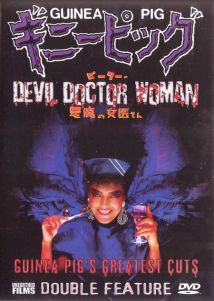
Guinea Pig 4: Devil Doctor Woman (1986)

Guinea Pig 4While Guinea Pig 3 tested the waters by branching out in a more comedic direction, the 4th installment, Devil Doctor Woman, jumps in with both feet, taking the series from horror to full-blown slapstick comedy. It still manages to be violent and disturbing but the tone is the absolute polar opposite of the first two, so different in fact that it is baffling that it could even be considered part of the same series. So, does this even more extreme tonal shake-up still manage to deliver the kind of satisfyingly gruesome experience we’ve come to know and love from these films? Well, let’s discuss.
The film is essentially just a series of bizarre sketch comedy shorts that center around the unlicensed transvestite “doctor” known as the Devil Doctor Woman. There isn’t an overarching plot to speak of, just a series of nine disconnected segments with the only commonality being the presence of the Doctor or her alter ego, the Cleaning Lady. The segments themselves typically involve the Doctor introducing patients who are suffering from outlandish afflictions and attempting to cure them in weird, violent ways.

It isn’t really worth delving into the writing as nothing about this film is taken seriously and every segment is merely created for the purpose of eliciting gross-out laughs. Although, I’m not sure who’s laughing, because each of the witless segments provides little more than gags about body functions that feel like they were written by demented twelve-year-olds. Now, I’m all for fucked up comedy, but I do have the crazy requirement that it actually be funny and not just incredibly irritating.

One of the main things that made the previous Guinea Pig entries work so well, was the highly detailed, shockingly realistic violence. In this case though, the only thing shocking is how cheap and poorly crafted the special effects look. Heads explode on obvious mannequins, bad make-up reveals bald caps and the less said about the cheap Halloween prop with the floppy rubber spikes the better.

All that being said, though, there were some, but not many, positive aspects of this film. For instance, the segment involving the “Tasting Party of Human Flesh” was a brief highlight that made the film feel at least somewhat connected to previous entries. The idea of a posh gathering where people sample grotesque dishes like Cancerous Liver Curry and Severed Vagina in Blood Sauce at least show a level of gruesome creativity, despite the fact that the props still look like they were bought at a discount costume shop. There also is potential to the concepts in many of the segments, but poor execution and the baffling reliance on the over the top “comedy” completely sabotage them.

Overall, a poorly conceived concept and a baffling direction to take the film series in. The first three entries are well worth watching but new fans of the series would be better off skipping this one entirely. Just like the fourth season of Arrested Development this entry adds nothing of real value and only taints the memory of the three fantastic installments that came before it.

1-star-red

Guinea Pig 3: He Never Dies (1986)

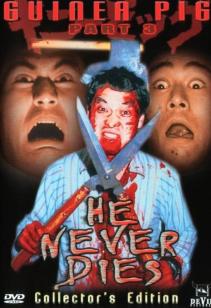
GP3 He Never DiesFor its third entry, the Guinea Pig series goes in a very different direction with He Never Dies. Instead of the somber, grueling brutality of the first two, this film adopts a lighter, comedic tone. In fact, rather than classifying this entry as true horror, it would be more accurate to describe this installment as a black comedy, albeit an exceptionally violent one. So, does this incredibly risky stylistic shake-up actually work in a series known for realistic Snuff impersonation? Well, let’s discuss.
In addition to the change in tone, this is also the first entry to really use a conventional plot structure with clearly defined character motivation and a traditional story arc. At the center of that story is Hideshi (Masahiro Satô), a depressed office drone who just can’t catch a break. When he decides he’s finally had enough and cuts his wrist, he makes the shocking discovery that not only can he no longer feel pain…..he can’t die at all. Although initially distraught, he soon comes to the realization that he can use his new found powers to terrorize a coworker he’s jealous of. I know, hilarious, right?

So, while that may not sound at all like something that even resembles comedy, the story itself is portrayed with a goofy, over-the-top and undeniably comedic tone. Because this is such a jarring change from the previous films, it is best not to try and draw comparisons between them and simply view this as a stand-alone entry. Regardless, even at forty minutes, it still manages to feel long at times and you may spend the first quarter of it asking yourself “How the fuck is this a Guinea Pig film!?” Patient viewers will be rewarded though, because once it starts gaining momentum, it unleashes the well-crafted, gruesome effects the series is famous for.

Initially, I myself was very skeptical of the idea of a comedic entry in the Guinea Pig series, but since the first two films have such scant plotting and no overarching story to connect them, simply showing women getting tortured over and over again in the sequels would create stale, diminishing returns. In this case, things weren’t just changed, they were flipped 180 degrees. Rather than a somber, anti-plot structure showing violence inflicted upon women, it gives the viewer a comedic, classically structured film where a man inflicts violence upon himself.

So, while it may not deliver the traditional Guinea Pig experience, this is a bizarre piece of hyper-violent absurdist comedy that is surprisingly enjoyable and well worth the very minimal time investment.

3-stars-red

Guinea Pig 2: Flower of Flesh and Blood (1985)

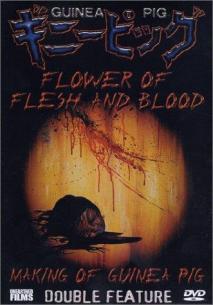
GP2 Flower of Flesh and BloodThe Devil’s Experiment may have kicked off the Guinea Pig series but the second installment, Flower of Flesh and Blood, is where it really starts to come into it’s own, providing a far more gruesome and brutal entry. It also gained significant notoriety in the states back in 1991 when Charlie Sheen (yes the Charlie Sheen) saw it, was convinced it was a real snuff film and reported it to the FBI. As laughable as this may seem, it’s not completely without merit, as the lack of story and hyper-detailed gore was specifically crafted to give the viewer the impression they are witnessing a real crime. Additionally, the film does start with text stating that the movie was actually a recreation of a genuine snuff film that writer/director Hideshi Hino had received from a crazed fan of his Manga work.
This story became the stuff of urban legend for years and Hino did become the subject of a police investigation because of his work. But despite what some persistent rumors claim, he never actually had to appear in court because of it and revealed years later in a Vice interview that the part about receiving an actual snuff film was a complete fabrication. So, notoriety aside, how does Flower of Flesh and Blood actually hold up as a film? Well, let’s discuss.

Much like Devil’s Experiment, this entry is also light on plot but does actually have a clear narrative structure. It starts with an unidentified woman being chloroformed and kidnapped as she walks alone at night, later waking up tied to a table in a windowless room where torture implements lie about. Her white-faced, Samurai helmet-wearing assailant quickly gives her a mysterious drug that will “turn her pain into ecstasy” before graphically disassembling her body with his crude torture implements. I won’t reveal too many details about what plot there is but suffice to say it does come to a thematically satisfying conclusion that also leaves the door open for a continuation of the twisted story.

The entire film may only be forty-two minutes but packed within that is more gore than you’ll see in many feature-length horror movies. It also achieves a level of graphic brutality that goes far beyond what most other films have the balls to portray and even thirty-two years later, the special effects still look amazingly real. This is largely due to the fact that Hino goes into great detail to show how slow and laborious the process of taking apart a body actually is. This is a level of detail that is often skimmed over in films but as anyone who’s broken down a chicken before knows, it takes a significant amount of effort to cut through bones and joints.

There are also numerous aspects beyond just the gore itself that make this film a very disturbing experience. For one, seeing a person who’s awake but not crying out in pain while someone mutilates their body is actually more disturbing in a way and is incredibly unsettling and surreal. There is also the scene where the white-faced Samurai shows off his “collection” of maggot-infested body parts while an eerie voice recites a poem about Hell in the background. It’s a simple and strange effect that works incredibly well to enhance the disturbing, surreal experience of the film.

The disc from Unearthed Films also includes a making-of featurette which is very interesting to watch after the film. Not only does it show the level of detail that went into crafting the amazing effects but also has outtakes showing the cast and crew joking around and bursting into laughter in-between takes. That itself is perhaps the most surreal part of the entire experience. All in all, a classic piece of horror cinema that’s worthy of it’s cult status and belongs in the collection of any serious gore hound.

4-stars-red

Guinea Pig: Devil’s Experiment (1985)

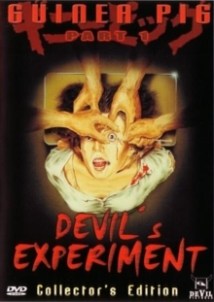
GP1 Devil's ExperimentHorror fans familiar with the notorious Guinea Pig film series will most likely remember them as “those fucked up faux snuff bootleg tapes” that circulated through underground horror communities in the ’80s and ’90s, much like the Faces of Death films. Even now, the original series is very hard to come by and fans of underground horror will need to be prepared to spend hundreds of dollars on the out-of-print box set, if they can find it at all. But find them I did, because no list of the most extreme horror films could possibly be complete without them. I also wanted to see how these films held up in the age of modern Torture Porn and if there was a greater value to them beyond the shock factor.

The first film in the series, Guinea Pig: Devil’s Experiment has a “plot” that can be easily summarized as “three men torture a woman for forty-three minutes.” However, it would be a mistake to simply write this film off as a misogynistic torture fantasy because there is a lot more to unpack about it than initially meets the eye.

First of all, this is an experimental film and should be viewed as such. The plot itself is not as much of a relevant factor in this case, since the experience is more about the provocative imagery and a visual representation of raw human cruelty and suffering. What’s more relevant is whether or not the film holds the viewer’s attention. In this case, despite the absence of a conventional plot and defined characters, it manages to keep you engrossed and curious to see what comes next as the violence increases in intensity.

A good storyline is an essential component to making a quality film so without that, a movie can’t achieve true greatness, no matter how interesting the visuals are. However, there is certainly something to be said for a film that strips away all pretense of story and presents the raw horror of brutality that is the primary draw for the fans to begin with.

Also, within those visuals, there are a lot of interesting and innovative techniques that are applied. For instance, the use of sound as a torture device, as they strap headphones on her and subject her to 20 hours of blaring noise, enough to drive any normal person absolutely insane. It’s an interesting idea and one that hasn’t been utilized very often since, despite the plethora of creative torture that’s been featured in countless films since. The hot oil scalding and hand crushing are also worth noting but the real standout is the needle through the eye, a ghastly and brilliantly executed effect that still holds up decades later.

All this aside though, what really makes Devil’s Experiment significant is how pioneering it was and it’s substantial contributions to the genre as a whole. A primary example of this is how the film is bookended with text telling the viewer that this is a “private video” the unknown writer of the narration obtained and that the info about the people involved is “missing”. Certainly not the first example of a “found footage” film but definitely a very early and influential example that would help pave the way for an entire subgenre some years later.

It’s also interesting to note that the tactic actually worked a little too well and producer Hideshi Hino had to prove to authorities that no one was actually hurt during the making of the film, just as Ruggero Deodato had to do with Cannibal Holocaust a few years earlier.

Another significant contribution is that this film was one the earliest, if not the earliest, examples of a Torture Porn film, despite the fact that the actual term wouldn’t be officially coined for another twenty-one years. So, regardless of how well the film overall holds up, there is no denying its important influence on not one but two subgenres of horror.

Despite it’s historical significance, I do have to concede that the overall watchability of the film isn’t terribly high and many of the less remarkable scenes do drag on a bit with little to hold your interest. Not to say there isn’t enough there overall to keep you watching, but that doesn’t mean you won’t be checking your watch during some scenes, especially towards the beginning. Regardless, this is undoubtedly a film worth tracking down, not just for the couple of scenes of effective gore but also to witness a piece of underground horror history for yourself.

3-stars-red

I Spit on Your Grave (1978) vs I Spit on Your Grave (2010)

I Spit on Your Grave

What separates the I Spit on Your Grave films from most other movies in the genre is that the primary source of horror is derived from rape rather than other forms of violence. While the rape/revenge subgenre certainly does exist within the genre as a whole, it is not utilized nearly as often as others, most likely due to the fact that it is so difficult to strike the proper balance when presenting the subject matter. The ideal depiction of a rape scene on film is one that acknowledges the horrific nature of the act without overly sexualizing it or downplaying the severity of it’s impact on the character. I Spit on Your Grave is generally cited as the quintessential rape/revenge horror film, but which version is able to more effectively explore what is easily one of the most taboo subjects in film? For that matter, does either version depict the central act properly? Well, let’s discuss.

Before I start, I do want to mention there are some spoilers regarding the plot so if you have not seen these films, I would recommend doing so prior to reading this. Okay, all set now? Let’s continue then. Both films follow the same basic plot structure in which novelist Jennifer Hills rents an isolated cabin in a rural town to focus on writing her book. Before long she is brutally raped and beaten by a group of men and left for dead. Once she physically recovers she seeks her gruesome revenge.

Considering the fact that the remake sticks very closely to the story of the original, it is almost baffling how different the final results are. Although, once you start examining the details, it becomes very apparent why the original is able to be a harrowing portrayal of sexual violence that is still genuinely disturbing nearly forty years later and why the modern version is the kind of trite piece of shit that makes people hate remakes in general.

Let’s start with the most important part of the story in both films: the rape scene. In the original the event unfolds in real time, only using time-lapse cuts when characters are traveling between locations. In this version, writer/director Meir Zarchi forces the viewer to bear witness to every horrific moment of the progressively brutal violation without reprieve. There is also a palpable sense of dread, not only before but during the act as Jennifer is clearly hoping the ordeal will be over after each assault, only to have it begin again. In this way Zarchi doesn’t let the viewer off the hook but forces them to confront every moment of the horror she has to experience.

Far from being an exploitative tool to titillate the viewer, this realistic, unflinching depiction shows rape for the vile act it truly is. I’ve always said “horror should be horrifying” and when disturbing subject matter like rape is explored, it should be done so in a way that actually disturbs the viewer, not simply presented like a sex scene that’s designed to excite. This is why there is far more cultural value in the realistic way the original, and films like Irreversible, depict sexual violence than films that sanitize it. It is an important reminder that rape in the real world is a horrible thing and one that should be taken seriously.

The remake on the other hand delivers the standard version of what Hollywood thinks passes for edgy and realistic but is, in reality, playing well within the established safe space of the average viewer’s comfort zone. It is still disturbing but comes nowhere near the unrelenting brutality of the extended, punishing realism of the original. It also self-sabotages by only showing two of the men actually committing the rape and merely implying the involvement of the others. I can’t think of any reason for this other than a misguided attempt to spare the delicate sensibilities of the viewer, despite the fact that all of them being involved is a key part of the story.

Speaking of misguided, the choice in the remake to have Jennifer disappear into the river after the rape and then start stalking the men with borderline supernatural abilities, like she’s fucking Jason Voorhees, was an utterly terrible decision. It took the film from the gritty realism of its source material and plunged it deep into mediocre Slasher territory. By doing so, it also cuts out what is perhaps the most poignant and devastating part of the original which is Jennifer dealing with the aftermath of the crime. This, along with the lingering shots of her in between assaults, is important because it further humanizes her and reinforces the traumatic fallout this event is causing her life.

Another aspect of the original that is a key part of delivering the emotional impact is the excellent performances. Camille Keaton’s fearless and emotionally raw portrayal of Jennifer is an essential component of the original’s success.

That point is reinforced in the remake, as it is very clear that Sarah Butler is not up to the task and her stilted performance never lets you forget that you are watching someone trying to act. Although that can really be said for pretty much the entire cast of the remake, who all feel like poorly sketched stereotypes straight out of central casting. Even the initially goofy depiction of the simple-minded Matthew in the original is made all the more chilling when he proves that, despite his initial reluctance to participate, he is just as willing to indulge in his darkest base desires as the rest of the men.

There are also so many brilliant, subtle points in the original that are completely lost in the remake, seemingly because director Steven R. Monroe couldn’t grasp their significance. For instance, the fact that the men in the original mock and destroy her writing towards the end of the ordeal, as though they are trying to make their domination and destruction of her complete by also emotionally violating and destroying her. In the remake it is thrown in as a relatively inconsequential afterthought before the rape begins.

Another important point in the original is that her sexuality, the very reason they targeted her in the first place, is a key tool in her revenge, a fact that is almost completely excised from the remake. In the original, it is also made clear that the men are not just mad at her but actually blame her for the fact that they felt compelled to violate her. This is a subtle but very important commentary on the kind of mindset that perpetuates rape culture in our society and one that is totally glossed over in the remake.

The original also adds a layer of complexity by efficiently establishing the fact that, despite being capable of horrific crimes without regret, the lead rapist Johnny is also a loving and attentive father. This doesn’t excuse his actions, but it does serve as reminder that other innocents will suffer the fallout if he is served with his well-earned comeuppance. There is an attempt in the remake to invoke a similar familial tie with the character of the sheriff (who was invented for the remake) but it is belabored to the point of rendering it ineffective.

To be fair, the gore itself in the original, while creative, does look quite dated by today’s standards. Even though the effects are updated in the remake, and overall do look good, they are simply the same run-of-the-mill post-Saw set pieces we have seen in pretty much every horror film since the beginning of the millennium. In the end, this is one of the most clear cut examples of how no amount of slick production values can justify the existence of a remake that doesn’t preserve the aspects that made the original great in the first place.

Winner I Spit on Your Grave 1978

Night Kaleidoscope (2017)

Night KaleidoscopeSome movies are created with an emphasis of style over substance, a deliberate attempt by the filmmaker to craft a compelling and surreal world that does not adhere to a standard narrative format. Suspiria, Lost Highway and Beyond the Black Rainbow are just a few examples of when this artistic gamble really pays off and pulls viewers into a compelling, living nightmare that brings you along for the ride, even if it’s not always clear where that ride is taking you. Conversely, when not done properly a lack of narrative only succeeds in creating frustration and quickly bores the viewer with a series of meaningless images. So, where does a film with a hallucinatory, dream-like style like Night Kaleidoscope fall on the spectrum? Well, let’s discuss.

The plot (such as it is) centers around Fion (Patrick O’Brien) who uses his hereditary psychic abilities (along with the unknown mystical drug he smokes) to help solve crimes. His current case involves a vampire couple that are responsible for a series of murders in the city slums. He is soon joined by Isobel (Mariel McAllan) a mysterious young woman who seems to have a personal stake in wanting to defeat the vampire couple.

First of all, I want to acknowledge the style of this film and the fact that director Grant McPhee effectively uses a variety of techniques to create an authentically surreal, dream-like experience. Quick edits, single-color saturation scenes, deliberate out-of-focus shots and a purposely shaky handheld camera all work together to deliver a fluid sense of movement that is disorienting and nightmarish in the best possible way. The pulsating and ominous 80’s style synth score that’s underlaid throughout adds to the hallucinatory effect of the film and perfectly compliments the striking visual style.

However, one key aspect that separates this film from other surreal classics like those I previously mentioned is the fact that it doesn’t commit fully to the surreal tone it establishes. Swirling, disorienting montages are broken up by scenes with more standard structure and pacing. That’s not necessarily a bad strategy in general as you don’t want to burn out your viewer with images that risk becoming repetitive and meaningless, plus it can be a good time to communicate key plot information. But, in the case of Night Kaleidoscope, this is where it comes up short because unlike films where the whole plot is up to interpretation, this one has a pretty straightforward narrative, it’s just got some holes in it.

For instance, the fact that there is clearly meant to be a greater significance to the character of Isobel but it is never properly established in the plot. This leaves unanswered questions about her connection to the vampires that feel more like an oversight than a deliberate omission. Similarly, plot threads involving Fion’s employer who suddenly wants him off the case and his “psychic drug” supplier’s motivations are not properly fleshed out. This adds to an overall feeling of characters and plot points being introduced without the filmmakers having a clear understanding of how these elements work in the context of the story as a whole.

In general, the world the film creates is certainly strange. It’s a world where there don’t appear to be any mythic creatures other than the vampire couple but their existence is instantly and unquestioningly accepted. It’s a world where psychic detectives are commissioned by mysterious clients when a murder needs to be solved and actual police never appear regardless of the amount of bodies that pile up. In most cases, people in this world also seem very complacent when faced with the threat of death from the vampires but that fact does also lead to an interesting interpretation of this film as an allegory for drug use. Although, it remains unclear if that was the filmmakers’ intention as other aspects of the plot don’t necessarily support it.

Narrative issues aside, I really can’t overstate just how accomplished this film looks visually and the fact that it was made for the astoundingly low price tag of under $5,000 makes it all the more impressive. It also shows a tremendous amount of raw talent for visual flair on the part of McPhee who is a director that one would do well to keep an eye on. In the end this makes for an experience well worth having if you can let nagging concerns about plot melt away and embrace the mesmerizing surreal imagery. Indeed, this is the kind of film that is best when consumed late at night and slightly under the influence.

3-stars-red