In terms of production value, short films really run the gamut from goofy DIY productions slapped together with little forethought in someone’s backyard, to slickly produced professional pieces with Hollywood-level craftsmanship. With recording and editing equipment being more accessible and user friendly than ever, barriers to creating a film have never been lower, but the ability to create a good one remains as difficult and elusive as ever. Regardless of the tools and technology, the biggest factor in determining the quality of a film is how well it’s able to succeed on the most fundamental level of being “a good story, well told.”
With a total runtime of just nine minutes and the film itself being contained to just over six, Beyond the Moonlight doesn’t have a lot of runway to work with but from the beginning is able to establish a level of quality with rich atmosphere and beautifully executed shots. The story follows a young woman (Isabella Jaimie) furiously practicing ballet at night and performing for a strict task-masker (Alexandra Almendarez) who keeps demanding more from her. The film at this point gives strong Suspiria vibes and effectively builds tension with excellent camerawork, well-crafted lighting, and a particularly impressive shot that utilizes mirrors to great effect.
While I applaud the use of practical effects here the main misstep in the film is the fundamental tonal shift at the end that takes a tense and intriguing set-up and puts a button on it that’s downright hokey. The idea itself is solid and had the scene been taken a little more seriously, it could have ended on a much stronger note. That being said, I was still left wanting more as this whole film really just hints at the beginnings of a larger story and fortunately the short is already being adapted into a one- hour TV pilot. I’m truly intrigued to see how that goes because if writer/director Natalie Rodriguez is able to strike the right tonal balance we could have something really interesting here.
Availability: Unavailable
Currently there is no release date for the film but more info can be found on the official website here
Understanding the artistic intention of a filmmaker is key to being able to determine the quality of the work. While you usually don’t have the ability to hear directly from the artist what their work meant, you also shouldn’t need to because, if done successfully, the message and intention should be evident through the language of film, no matter how abstract the work. Sometimes you have to let go of traditional narrative expectations entirely to meet the film on its own level, embracing the vibe and symbolism the director is using. For The Benefactress (an exposure of cinematic freedom) the intention clearly isn’t to entertain the audience with the kind of fun escapism they can get from a mainstream theater but rather to utilize the tools of filmmaking to explore how far the boundaries of art can be pushed. Now, as with any work of art, the determination of how successful it is depends on if the execution can live up to the intention.
The film is the creation of writer/director Guerrilla Metropolitana and starts with a long text crawl that, among other things, talks about how the director’s previous work gained the attention of individuals in “high ranks of society” who have now decided to fund this project and see what an underground filmmaker can do with mainstream money. After that, an unassuming middle-aged woman named Juicy X reads a statement to camera about her previous experience with Metropolitana’s unconventional methods. She also states that the financial resources being provided by the mysterious benefactress known by the pseudonym “Elektra McBride” has brought a new quality to his cinema. Now that the copious amounts of funding have been firmly established, the expectations are officially set, and I can’t wait to see what this edgy, unfiltered, underground film with Hollywood level production values looks like. Sounds like we have another Serbian Film on our hands.
After over eight minutes of preamble, the main film is ready to start and most of the remaining hour of the runtime is devoted to Juicy X sexually assaulting another middle-aged woman in light bondage gear who seems to be her captive. Playing himself as the director/camera operator in the film within a film, Metropolitana records everything in shaky hand-held as Juicy X forceably inserts various objects into her victim and performs other sex acts onto her seemingly unwilling victim. This is done for the benefit of the benefactress herself who watches via a livestream monitor wearing nothing but a gimp mask while breathing in heavily from an oxygen tank and masturbating. The film is loosely plotted but does take some twists and turns as new characters are introduced and Metropolitana even steps out from behind the camera to take his turn raping the woman as well. Perhaps this section was inspired by the controversial Belgian arthouse shocker Man Bites Dog, or perhaps not.
It’s unclear where all of the mainstream money they kept referring to earlier ended up, it certainly wasn’t in the single apartment that served as the shooting location or in the generic film stock filter that was put on the digital footage in post-production. This isn’t something that I would normally draw attention to because I don’t hold a lack of budget against a production but if you are going to repeatedly introduce the idea of the film having a substantial budget then it should be called out when we don’t see any evidence of it on the screen. This brings us to the biggest issue with the film itself which is the inherent disingenuousness of the production.
Every aspect of this film seems intent on trying to deceive the viewer into thinking it’s something that it is not from the bullshit story about the funding in the opening crawl to the fake film grain to the ear piercing canned mic feedback sound that is added almost compulsively throughout. The greatest offender by far however is the fact that all the sexuality in this “exposure of cinematic freedom” is faked. Now, there is a point while we see Metropolitana humping the nameless victim where a voiceover of him comes in to let the audience know he is really fucking her but we’ll have to take his word for it because the angle doesn’t reveal anything. There is also a moment when we see what looks like cum spurt out onto Juicy X’s backside from behind the camera which may also be authentic since the boner that Metropolitana displays through multiple scenes very much is.
So, a few possible exceptions aside, the film is a fake, softcore simulation and I can’t for the life of me understand why a film whose whole thesis is centered around cinematic freedom is not even able to commit to its own premise and resorts to unnecessary self-censorship. Had this simply committed to the concept and delivered a truly unfiltered explicit experience then it would be a solid piece of boundary-pushing filmmaking but as it is, it feels stifled and restrained and there isn’t enough of a story or creative film techniques to make up for it. There are so many films out there that effectively utilize explicit sexuality as a form of artist expression and Metropolitana should take cues from films like We Are the Flesh, Shortbus, 29 Needles, Flesh Eater X, Baise-moi, XXX: Dark Web, Portraits of Andrea Palmer and so many others that boldly push the limits of cinematic freedom and don’t simply take a half measure. I truly think Metropolitana could be capable of delivering some really interesting boundary-pushing art if he takes the gloves off and makes a film that owns and celebrates what it is instead of trying to convince you that it’s something that it’s not.
Availability: Limited
The film is being distributed by Blood Pact Films and can be purchased on their official website.
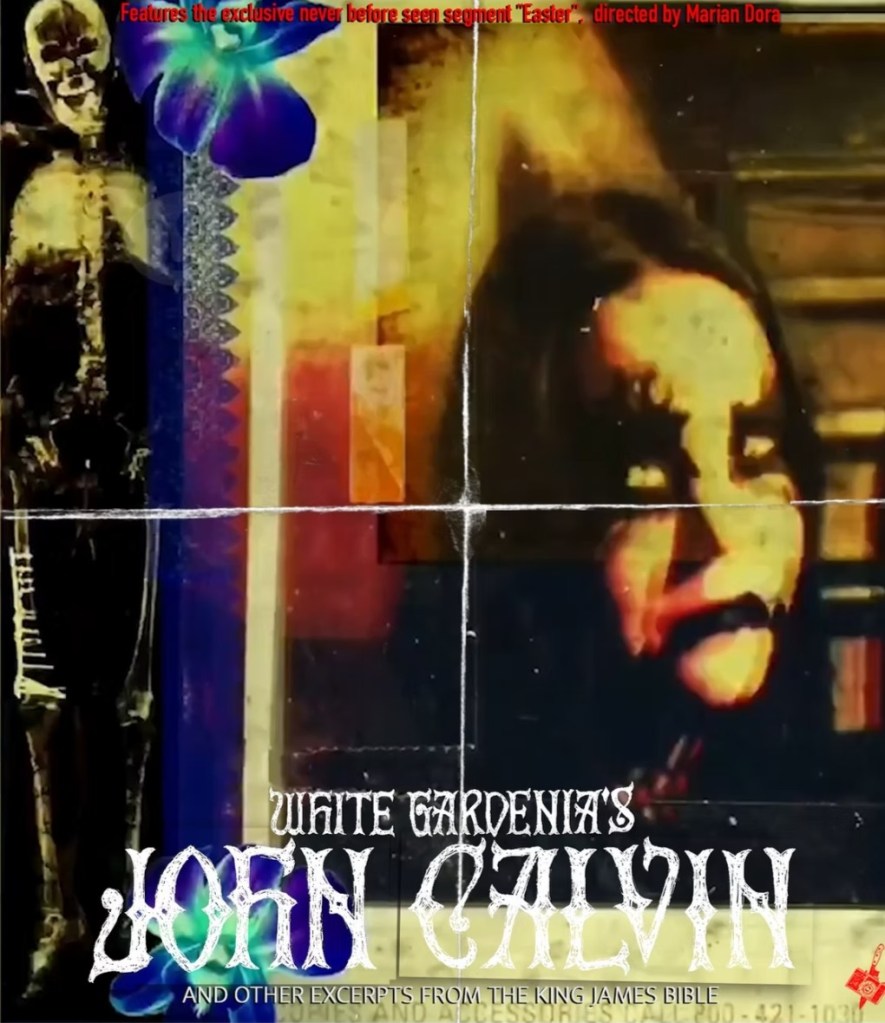
Art’s inherent subjectivity is never more apparent than in abstract films. Without a traditional narrative structure and so much of the imagery left up to interpretation, the goal isn’t so much about determining whether something was “good” or “entertaining” so much as it is understanding the artist’s motivation and goals and whether or not they were able to achieve them. Spearheaded by underground artist Daniel Valient, White Gardenia’s John Calvin is in many ways a significant departure from the style and content of their previous works in part because it shifts focus from nudity and self mutilation to biblical stories and also because it represents a collaborative effort with multiple other filmmakers.
Unlike traditional anthologies, the various parts aren’t clearly segmented by filmmaker and instead flow into each other with brief text on screen sometimes indicating the switch to a different segment. The presentation is a real variety of mixed media from static collage imagery accompanied by discordant and distorted soundscapes to live action scenes and old silent film footage reworked and reedited into Found Art style segments. This does make for a bit of an uneven tone as the highly produced black and white scene from Marian Dora (Melancholie der Engel) presents a much more professional tone than some of the less successful live action segments whose costumes and camerawork have a much more DIY aesthetic to them.
This collection is on a whole a very interesting and unconventional piece of artistic expression but is at its least successful when it leans into an over-reliance of on-screen text or direct voice-over to communicate the ideas presented in it. There are a lot of interesting concepts and ideas here dealing with religion, transhumanism, death, and resurrection but I would challenge Valient and the other artists to rely on their talents and abilities to process these concepts through a creative filter and express them more abstractly than simply telling it to the audience. I also found the choice to include footage that was clearly filmed handheld from another screen to be curious rather than just incorporating it into the footage itself.
The times when this film is at its most successful are when it’s able to lean into the surreal and bizarre aspects and run wild with them. The make-up effects on the lepers were truly inspired and genuinely haunting but the most interesting part of this experience is without a doubt the use of the bizarre collage imagery. The use of this creative technique, incorporating some moving images into a mostly static scene, coupled with distorted audio made for a unique and intriguing experience. I also like how the old footage was recontextualized into something strange and new and there were points that were reminiscent of early Lynch shorts and the kind of dark anatomical visuals Marilyn Manson used during his most provocative period. The time-lapse decomposition also brought to mind Peter Greenaway’s deeply unsettling masterpiece A Zed and Two Naughts.
Ultimately, a bit of a mixed bag as collaborations typically are, there are moments of experimental brilliance here and a more streamlined version that pairs down the overuse of text throughout would probably be more successful. While the effectiveness of the overarching message in the film will undoubtedly depend on your personal connection to the tenets of Christianity and interest in transhumanism, I always appreciate art that takes big swings and isn’t afraid to use highly unconventional and experimental ways of expressing ideas.
At long last the wait is nearly over! The Profane Exhibit, an anthology collection of Extreme Cinema shorts by 10 of the most boundary-pushing directors is finally making its home media debut via Unearthed Films after notoriously languishing in post-production for eleven years after its initial festival premiere in 2013. I couldn’t confirm the specifics about the cause of the extended release delay but situations like this tend to come down to unglamorous explanations involving rights issues and personality conflicts. While many fans of underground horror have been eagerly anticipating its release, the unusually long waiting period was the cause of much restless grumbling online and even speculation that the film itself was nothing more than a myth. So naturally, the first question on everyone’s mind is going to be “was it worth the wait?” Well, let’s discuss.
Each of the 10 segments is a standalone piece by a different director and are completely unrelated with only some strange footage of meat processing acting as the connective tissue, if you will. The films vary in content and quality as is always the case to some degree in anthologies with the overarching connection seemingly being “just make something super fucked up”. That’s certainly a sentiment I can get on board with as well as a collection that features heavy hitters of underground cinema on both sides of the camera…..and Uwe Boll. Ruggero Deodato (Cannibal Holocaust), Yoshihiro Nishimura (Tokyo Gore Police), Marian Dora (Melancholie der Engel) and many others all contribute segments for an unprecedented collection of international talent. On the other side of the lens, some notable highlights include legendary character actor Clint Howard (Ice Cream Man, Arrested Development) taking an exceptionally dark turn in Boll’s segment Basement, and Eihi Shiina (Audition, Tokyo Gore Police, Helldriver) crushing it in Nishimura’s Hell Chef segment like the absolute fucking legend that she is.
One of the key factors of an anthology is how you structure the segments. Ideally, the first one out of the gate should grab hold of you and set the tone of things to come until the film culminates in a showstopping finale. Unfortunately, this is where The Profane Exhibit is guilty of a major misstep by opening the collection with the tepid and underwhelming Mother May I by Anthony DiBlasi. The short tells the story of a sinister nun who deals out draconian punishments to the young women in her charge and while it is a perfectly serviceable horror short with some inspired creature effects, it feels out of place in a collection that is supposed to be centered around the concept of boundary-pushing extremity. This anthology would have been much better served by opening with almost any other segment from the collection and Hell Chef, Tophet Quorom or Manna would have all been exceptionally good ways to kick things off.
The weirdest outlier of the whole anthology is unquestionably Deodato’s segment, The Bridge. For many horror fans, Cannibal Holocaust acts as an entry point into world of darker and more obscure Extreme Cinema and even numerous genre fans who can’t stomach it are at least aware of what it is making Deodato probably the most recognizable name in the whole collection. Given the pedigree of his most notable work, it is utterly baffling how tame and innocuous his entry was. Sure, the idea is dark but this short blip of a film barely registers as horror and definitely not as something that should be in an Extreme Cinema collection. Rest in Power to a legend though.
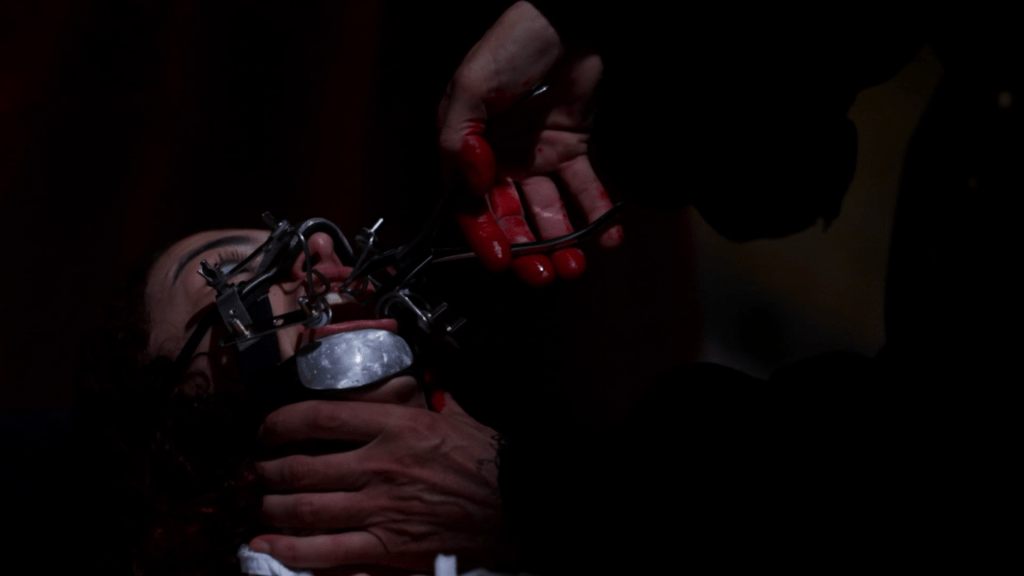
Now I want to focus on some of the things this collection does right, because there are a lot of them. Dora delivers a tour de force with his brilliantly directed and utterly bleak (naturally) entry Mors in Tabula about a doctor called to a rural town to aid a severely ill child in World War II era Germany. Hell Chef is a very fun and brutal entry that delivers a pitch-perfect slice of Japanese Splatter Gore and while there may not have been a lot of substance to Manna, I thoroughly enjoyed it for the unrelenting visual feast of sex and violence that it was.Basement and Goodwife are both solid entries in the “human monsters hiding in plain sight in suburban America” subgenre and Tophet Quorom is an excellent segment about an evil cult that brings a well-realized story to life along with some ferocious violence. I like how the aptly titled micro-segment Amouche Bouche ties into the “meat” segments that are intercut between entries throughout. The real stand-out in this collection though is Nacho Vigalondo’s Sins of the Father. This one starts with such a strange and jarring premise that unfolds and reveals itself in unexpected ways to unveil the immensely dark and unpredictable narrative. The truly unique quality of the story coupled with the expertly crafted production make this one a haunting and mesmerizing experience that will stay will you far longer than some of the more overtly violent entries here.
I’ve seen some pretty mixed chatter about this film lately and part of that may be due to its legendarily long wait time before release building expectations to an unmatchable degree. Is it everything it could be and everything we could want in an Extreme Cinema collection that pushes the boundaries farther than any others dare to go? No, it has its missteps but there is far and away (Clint Howard reference, couldn’t help myself) much more good than not. While it’s not perfect, The Profane Exhibit is a daring and provocative collection of art that fans of twisted, underground cinema won’t want to miss. So yeah, it was worth the wait.
Availability: Upcoming Release
The film will be released through Unearthed Films on September 24th, 2024 and can be preordered here.








 Horror and Alternative Cinema Reviews