“Show, don’t tell”, an old adage that rings especially true for the visual medium of film and one that writer/director Anthony Cally has fully embraced with his dialogue-free short, Waiting. It’s a credit to Cally and everyone involved that his story about a group of people waiting in a bar was so engaging that I wasn’t even cognizant of the fact that no one had spoken a word until after the film finished. It’s a bold move to try and communicate a concept without words, but the brilliant acting, gorgeous, professional production design, and the exquisite use of sound to guide the narrative all work in concert to create a stunning final product.
The story itself is very clever and while it might take viewers a couple of watches to pick up on exactly what is happening, all the clues are provided if you look carefully. As more information is revealed the tension becomes palpable as this seemingly innocuous location is clearly anything but normal. While it does function perfectly as a self-contained story, the world was so engaging that I would love to see it as a springboard into a feature-length continuation. At just about six minutes, this bite-sized short left me hungry for more and as soon as it was finished I immediately had to watch it again. Here’s hoping we see a lot more of Anthony Cally in the future, and that we’re not left waiting too long for his feature debut.
As we rely more and more on technology to make connections (especially as the ever present quarantine isolation marches on) it makes sense that tech based horror would become more prevalent in the genre in new and interesting ways. Just as Host did last year, Filtered is able to effectively communicate horror and anxiety in the simple yet brilliant format of video chat. With a runtime of less than six minutes, writer/ director Vincenzo Nappi doesn’t have a lot of time to establish characters or backstory, yet is able to make both Jasmine (Jasmine Winter) and Marco (Marco Carreiro) immediately feel genuine and real with the sparse information provided. This goes a long way to making their initially mundane conversation all the more familiar at the start and therefore more frightening by the climax. With simple yet effective imagery that recalls the classic David Lynch shortThe Alphabet at times, this is an amazing piece of bite-sized horror that feels very apropos to the moment.
Typically in short films it’s best to dive right into the action and Forced Entry does just that as it plunges you into the world of psychotic drifter duo Arthur Maddox (Tom Lodewyck) and Donovan Hatche (James Bett Jr). The film follows the pair on a brutal killing spree over the course of a couple of days and was inspired by real life murderers Lawrence Bittaker and Roy Norris who raped and killed five young women in 1979. Even though brief footage of the real killers is shown at the end, the connection they have to the film probably wouldn’t have been clear to anyone who didn’t have the luxury of reading the highly detailed press kit. Even so, the shots do still serve to illustrate the point that our real world is filled with brutal, sadistic violence that usually occurs without much motive or rational explanation.
The story here is definitely pretty bare bones as most of the twenty-four minute runtime is taken up with extended scenes of mean-spirited violence. That’s not at all a bad thing in this case though, because even without a more robust narrative, the film still manages to be highly compelling with some truly impressive practical gore effects and excellent performances from the victims. It also makes sense given the fact that K.M. Jamison (who co-wrote/co-directed with James Bett Jr) said in a statement that the film is intended to function as a kind of showcase for what will hopefully be turned into a feature someday. In that regard it’s highly successful and I’m very on-board to see this nasty little story get fully fleshed-out in all its blood-soaked glory.
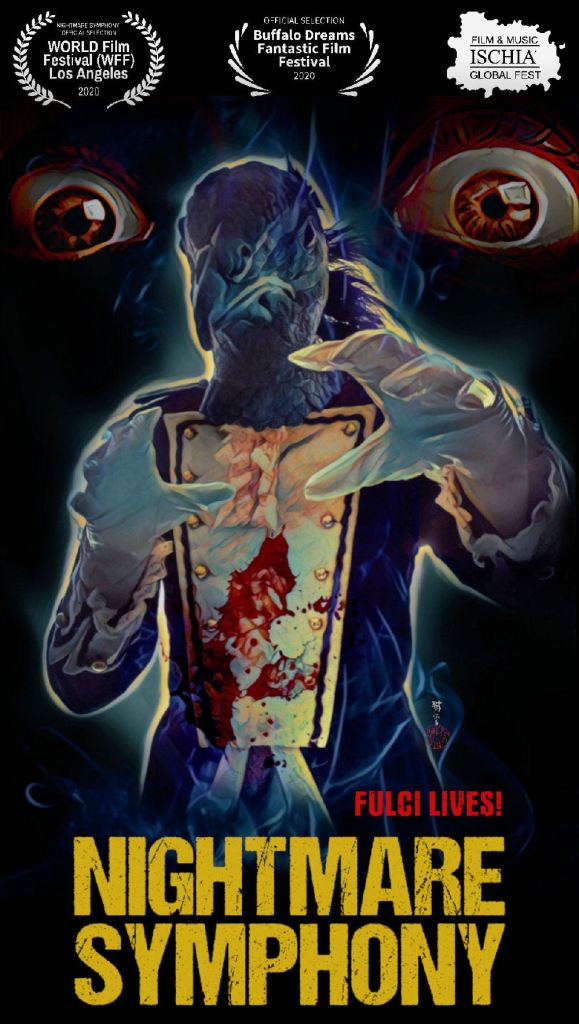
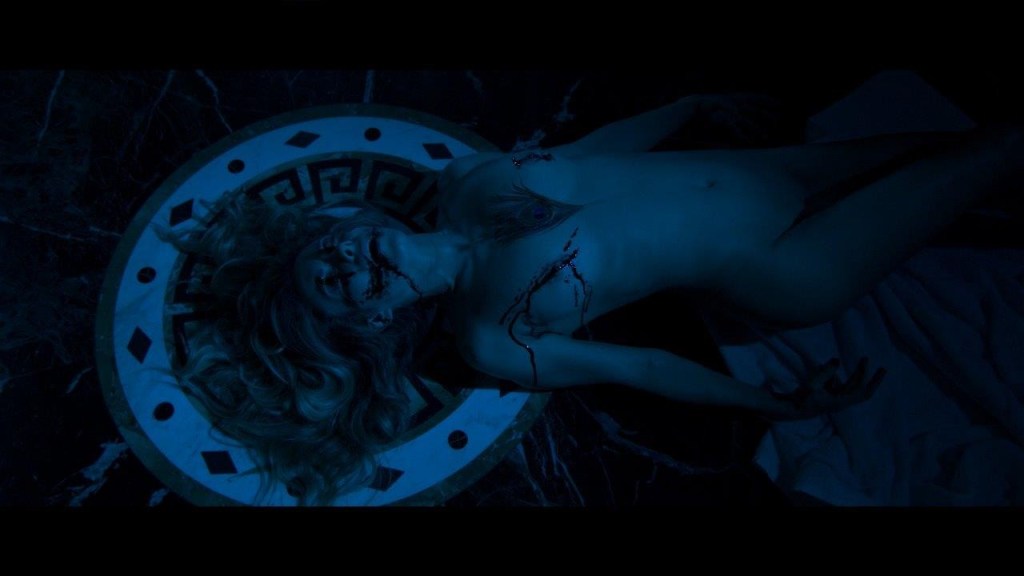
It’s interesting that the review for Nightmare Symphony would come directly after my review of Undergods since both films play with ambiguity and surreal imagery but achieve nearly opposite results. In this case, the Giallo-inspired film takes a big swing at meta commentary and the nature of reality with its story of an American director Frank (Frank LaLoggia) who goes to Italy to finish the edit of his film. Before long people all around him seem to be dying at the hands of a mysterious killer in a bird mask, who leaves no trace behind other than a peacock feather as their calling card.
Clearly this film is a love letter to Giallo itself, which is apparent long before the dedication to Lucio Fulci during the closing credits. On this front it succeeds wonderfully and the color-saturated scenes where the bird masked killer slashes up their victims with a straight razor to a pulsating synth score are a thing of beauty. In fact, I want to especially shout out all the FX work on this film because it is far and away the best part of the entire experience and every gory scene that features it is a work of brutal, bloody art.
What’s less successful is the story itself, as well as LaLoggia’s lackluster performance which never quite rings true, especially when paired with some of the actors in minor roles that are really bringing their A-game. It’s frustrating because I can see what writer Antonio Tentori (Cat in the Brain, Demonia) is trying to do but it simply does not come together. The ending (which I won’t reveal here) attempts to be very clever with a big meta reveal but falls utterly flat due to the fact that the preceding story in no way supports it.
Ambiguity in films can be a great thing, but a story that actively contradicts itself and feels like there are key scenes missing isn’t the same as not understanding a surreal film that’s filled with metaphor and symbolism. If you are going to play with the concept of reality itself in a film then you need to clearly establish what the reality of the world is and really understand when and how you are breaking with those conventions.
In this case Nightmare Symphony feels as confused as the viewer but attempts to cover its plot holes with stylized theatrics that it hopes will somehow congeal into meaning. Still, the film has a lot of style and a few carefully crafted re-shoots might be all it takes to fill in the missing pieces and tie the ending to the film that preceded it.
Going forward all reviews for short films can be found under the new Short Film Reviews section on the site. All previous reviews of shorts will now be found there as well as new short film reviews.
Is it necessary to fully understand a film to enjoy and appreciate it? I would argue that it is not, for if that were the case surrealist masters like Jodorowsky and Lynch would never have ascended to their exalted levels within the film world. We still watch, discuss and are sometimes confounded by films like Holy Mountain and Eraserhead more than four decades later because there is far more beneath the strange visuals that bares fruit if we are patient enough to peel back the layers. Surreal films benefit from re-watching and further examination, the trick is to make your films good enough that its worth an audience’s time to do so.
Writer/director Chino Moya’s first feature is certainly a film that requires additional scrutiny to fully comprehend. While it’s not as overtly surreal as the previously mentioned films the slippery narrative thread and dream-like quality give it a viewing experience akin to Holy Motors with a healthy dose of High Rise mixed in. There aren’t exactly main characters nor is there a clear narrative through-line as segments seem to flow into each other, sometimes in the guise of stories told between characters, and occasionally intersect.
The structure in fact is more on par with a collection of short films taking place in a shared universe where the edges are muddied enough for them to meld into each other rather than all serving a common storyline. We see body collectors nonchalantly tossing corpses into their truck like they are common trash, a middle aged couple who’s frosty relationship threatens to become upended by an unexpected guest, a father telling his daughter a bedtime story of an unscrupulous merchant, a post-apocalyptic prison and an ordinary business man whose life becomes incalculably more complicated with the arrival of someone from the past.
Some of these segments flow very cleanly into each other, whereas at other times the connection is a bit more abstract. Regardless of their storyline similarities it’s really the emotional thread of dysfunctional relationships in a bleak and hopeless world that connects and links the stories. More importantly, the purpose of this film is not to provide a by-the-numbers plotline but to create an evocative experience where well-realized characters flow into each other’s worlds with a dream-like quality and in that regard it is better served by the unconventional structure. The result makes for an incredibly engaging experience whose shifting narrative works well to simulate the feeling of watching an unnerving dream (or more aptly a nightmare) unfold and giving the audience plenty to mull over between viewings.
Fortunately the beautifully bleak cinematography that deftly captures the quiet horror of a ruined city and the across the boards flawless acting make this a trip that’s worth taking multiple times. If you are looking for a straightforward, easily digestible story that neatly resolves then this is not going to be for you. On the other hand, those interested in taking on a cinematic experience that provides depth and layers of meaning to be gradually unraveled would do well to give this a try.
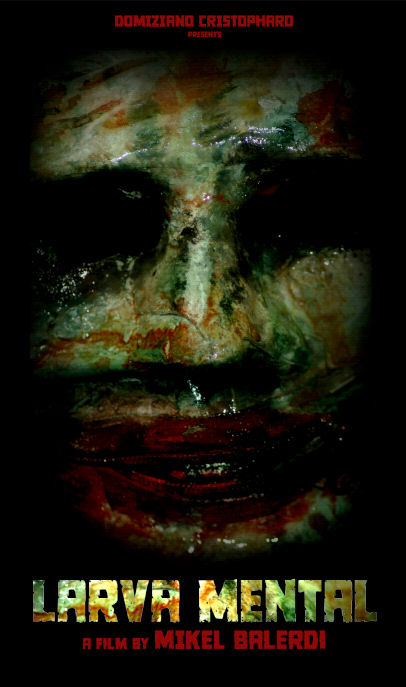
Larva Mental is a difficult film to talk about. For a lot of people this would be due to the extremely grotesque and graphic content, the mere mention of which is enough to nauseate and horrify the average viewer. I of course am not the average viewer and as someone who revels in the twisted grotesqueries found in the darkest corners of cinema, the content itself is no problem for me. Instead I find it difficult because I am of two minds about this film; one that thoroughly appreciates and champions the use of profoundly disturbing imagery and taboo performance-art and one that views the movie by the caliber of the filmmaking and the quality of the storytelling.
There are only two credited actors in the film, but since neither is given a character name, I will refer to them as The Father (Mikel Balerdi) and The Daughter (Daieri Gadna). Balerdi also wrote and directed, and the special FX make-up is credited entirely to him and Gadna, so clearly it’s a very DIY project. There’s certainly nothing wrong with that but the quality of the footage as well as the reliance on slightly shaky hand-held and static shots makes it very apparent that this was made without the assistance of a professional crew.
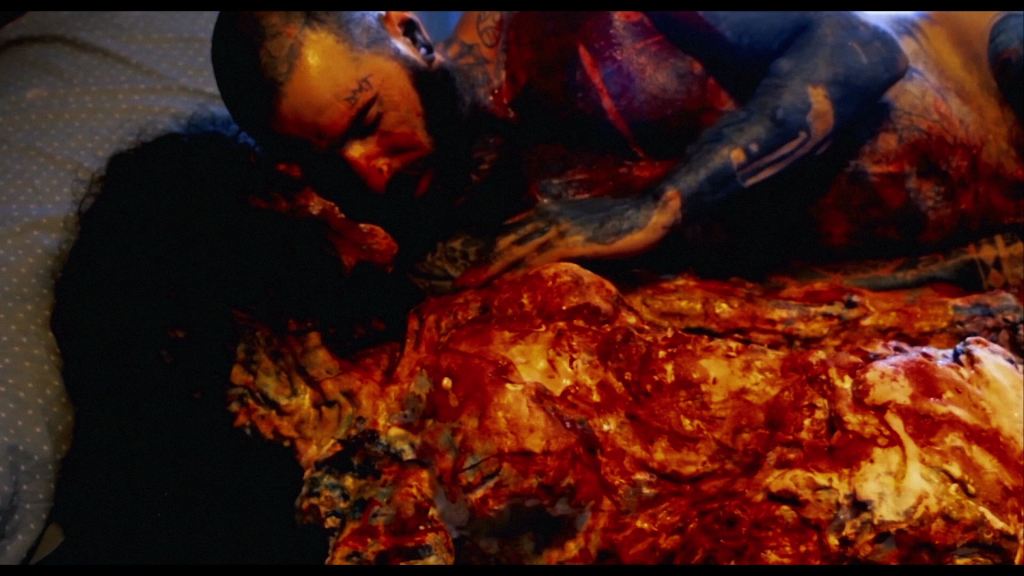
There is almost no dialogue in the film but the story is about a father and daughter who seem to have shared a trauma (and have an “interesting” relationship that involves sleeping naked together in the same bed). One day, The Father puts on a collar shirt goes away on what seems to be a business trip (although what business he works in with those face tattoos is unclear) leaving The Daughter at home to snoop around his computer. When she finds an intensely depraved video of him (that really must be seen to be believed) and some sketchy masks hidden away, she is so upset that she brutally kills herself. Upon discovering the body, he is so distraught that it sends him into a spiral of heroin shooting, self harm, and some good old fashioned corpse fucking.
The main draw of this film is clearly the spectacle of the various depraved scenes, but there is so much of them crammed into the short runtime that it starts to feel like a series of internet shock videos strung together with only a vague semblance of a story filling in the cracks. The rough video quality and down-n-dirty feel work well in service of the unsimulated shock scenes and reinforce the fact that this is indeed an example of legit extreme underground filmmaking at its nastiest. Conversely, the seams start to show a bit more when practical effects are involved. The corpse here doesn’t have the same level of high quality realism found in other films that are light on plot but heavy on gruesome body violence like AGP: Bouquet of Guts and Gore or Aftermath, which give the scenes with it significantly less impact.
Speaking of impact, the shock factor of the scenes would be higher if there weren’t so many of them back to back. Early scenes also ramp up the extremity quite high which results in them taking the wind out of the sails of those that follow and dulls their effectiveness. I would have greatly preferred that story and character development were given priority and that the level of depravity escalated gradually throughout to give it a stronger impact. With a runtime of just over an hour, there is plenty of room to weave the same amount of disturbing footage into a well established character arc that would give the scenes far more bite.
Based on the information I could find, this appears to be Balerdi’s first feature length film, but I hope we see more of him in the future. From a performance art standpoint, this film is able to go to levels that are exceedingly daring and bold and if Balerdi is able to put that same fearless, unflinching energy into a more well realized narrative, he could create some dark art that really shakes things up in the world of Extreme Cinema.
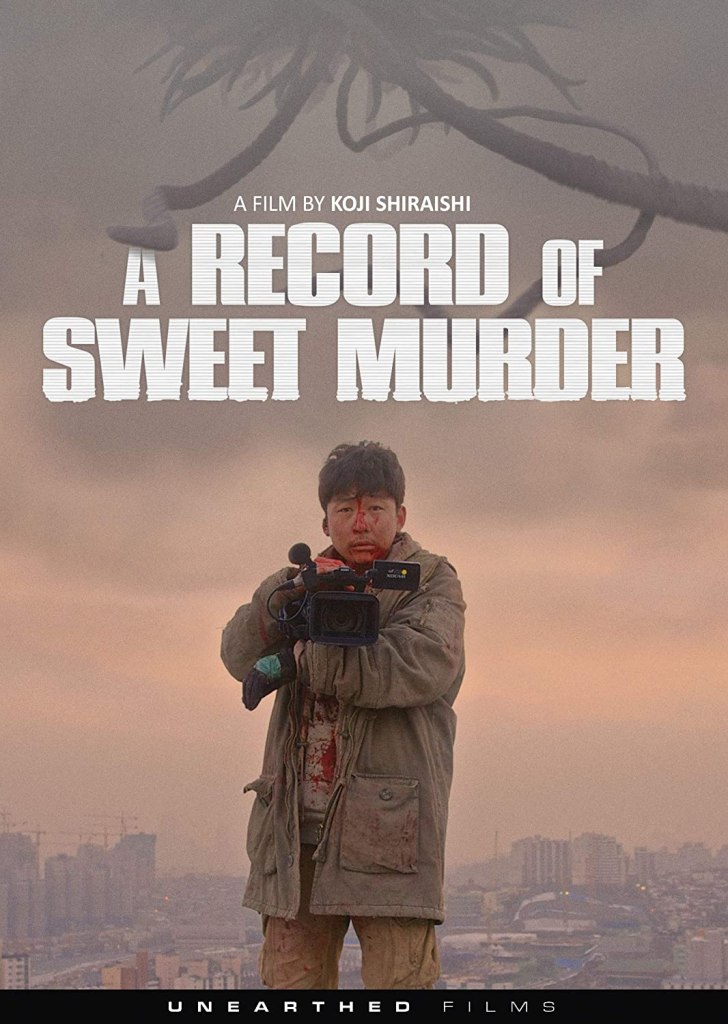
When The Blair Witch Project exploded onto the scene in 1999 it forever changed the world of horror cinema. In its wake, the once novel concept of a “found footage” film established by Cannibal Holocaust in 1980 quickly became ubiquitous within the market to the point of oversaturation. In the intervening years many filmmakers have used the audience’s willingness to embrace the rougher, naturalistic aesthetic of the style as an excuse for low production value as they churn out countless versions of the same basic story.
Thankfully, innovative filmmakers have also made their mark on the subgenre and films like Rec, Creep, and more recently Host (to name just a few) have elevated the style by taking it in new and creative directions. Innovation within the subgenre is rare enough but A Record of Sweet Murder is wholly unique as it dares to combine the found footage aesthetic with the rarest of cinema tropes, the single take film. By all conventional wisdom, an idea this ambitious could never work, but writer/director Kôji Shiraishi (Grotesque) pulls it off with results that are nothing short of mind-blowing!
The story centers around investigative reporter Kim Soyeon (Kim Kkobbi) who receives a call from Park Sangjoon (Je-wook Yeon), an escaped fugitive wanted for numerous murders. Park offers her an exclusive interview if she will meet him in a secluded location and bring along a Japanese cameraman. Since Kim and Park share a childhood connection, she believes that they will not be in any danger, but once they arrive it becomes clear that Park has a much larger plan in which they are to play an integral role.
To be clear, this film isn’t a true one-shot film like Russian Ark, but since everything but a few quick scenes at the end was done in a single take it’s still an incredible feat of filmmaking. It isn’t just the fact of doing it in a single take that is impressive, it’s what they are able to accomplish within the massive shot that is truly mind-blowing. Brutal fight scenes, multiple locations, numerous characters, realistic special effects, and an engaging storyline all work in concert to produce a thoroughly unique, mesmerizing experience. Even without the novelty of the single take this would be an incredible, well acted, and engaging film but the fact that Shiraishi goes the extra mile with a ground-breaking concept really puts it over the top.
It’s truly a cinematic travesty that such an innovative, brilliant film has gotten such little attention since its release yet Hitchcock’s faux one-shot film Rope is still talked about with such reverence after more than seven decades. I know that the cameras of the time limited the production to shooting it in a series of ten minute takes but Hitchcock’s blatant cutaways do absolutely nothing to preserve the illusion of an unbroken shot in that overrated “classic”. Despite this (and the fact that it felt more like watching a one-act play than a one-shot film) Rope was still innovative for its time and innovation should always be appreciated. To that end I’m hard pressed to think of many films in recent memory that have innovated more than ARoSM and here’s hoping that someday its style-blending brilliance will be appreciated for the unique achievement that it is.
For the uninitiated, vorarephilia (more commonly shortened to vore) refers to the fetishistic desire to be consumed or to consume another, typically for sexual gratification. As the opening text of this film clarifies, this has less to do with a cannibalistic desire to eat human flesh and more to do with the fanciful desire to be consumed by a much larger entity (human or otherwise), often swallowed whole. There are different types of vore, but as the title Vore Gore implies, this film focuses specifically on hard vore with a series of nine separate shorts all relating to gruesome, oral consumption of some kind.
In an apparent nod toThe Rocky Horror Picture Show the segments are introduced via disembodied lips, which imbue each title with a subtly salacious inflection. It’s the perfect framing device for a collection like this and the fact that the lipstick thematically ties to each film is an excellent touch. Though all segments do relate to the central concept, there is a wide variety of styles and approaches at play here, each reflecting the unique vision of their creators.
While Mouth, The Egg, and Infernal Gluttony 2 all take an abstract, experimental approach, other segments like Please, Not in My Mouth and Italian Ladies do it Better are more narrative focused horror shorts that bring their story arcs to a clear resolution. Other segments like Sweet as Honey, Finger Licking Good and Stretching take a more meditative (although no less gruesome) approach that falls somewhere in the middle. As I’ve now come to expect with anything relating to the band White Gardenia, their segment Yummy Fur belongs in a category wholly unto itself, but more on that in a moment when I delve into the individual segments in a little more detail.
It can be hard to maintain consistent quality when featuring a collection from various directors, but fortunately the segments in Vore Gore deliver high quality pretty much across the board, with each one bringing something interesting and different to the table, albeit with occasional mixed results. For instance, at first I wasn’t sure how I felt about relatively cheap looking special effects and seemingly simple concept behind Infernal Gluttony 2, but in the end, was won over by the sheer audacity of the engaging, surreal spectacle it created. Conversely, Finger Licking Good stood out as an incredible piece of work with its deliberate pacing and gloriously gruesome effects, but eroded some of the goodwill it achieved by tacking on an ending that feels like a bit of an unnecessary cop-out.
While there were a few minor missteps in some of the films, the only one that overall just didn’t work, was Italian Ladies do it Better. I hate to call out a single film like this, but in addition to having the least to do with the subject of vore itself, the highly telegraphed ending of the rather ludicrous plot simply doesn’t deliver in any kind of satisfactory way. The film also has trouble adhering to the rules of the world it creates and would have benefited from putting the script through another draft (or two). Stretching, on the other hand, was a highly satisfying and meticulously crafted piece of filmmaking that did an excellent job visually articulating the emotional experience of having a fetish. Though strikingly different in tone, another standout was Please, Not in My Mouth, a fun, nasty little film that I actually reviewed on its own back in 2018 but thoroughly enjoyed and was more than happy to revisit.
Speaking of films I’ve reviewed, anyone who has read my review of XXX: Dark Web knows that the film contains a segment in which Daniel Valient, of the band White Gardenia, completes an act of gruesome performance art that is fearless, shocking, and brutally real. In Yummy Fur, it’s Daniel’s turn to step behind the camera as the woman who filmed his segment in XXX: Dark Web (Cher Nevin) takes the spotlight for her own piece of hardcore performance art that threatens to outdo even that incredibly shocking scene. This is an amazing thing to witness, and my only complaint is that a unique, irrevocable act like this deserves really thorough and precise coverage to ensure no part of it is lost. Still, the erratic hand-held camera and occasional loss of focus actually work quite well with ambient music and cosmic-themed voice-over to give an unsettling, surreal quality to the segment.
Vore Gore may have a couple of chinks in the armor, but overall remains an overwhelmingly positive experience that I could continue talking about for pages. This is an excellent example of bold, unfiltered Extreme Cinema by a collection of brave artist who dare to push the boundaries of the medium in creative and provocative ways. Connoisseurs of authentic underground cinema take note, this is one twisted treat you’ll definitely want to devour.









 Horror and Alternative Cinema Reviews